
Published March 10, 2026 — This lesson is part of the French grammar curriculum developed by David Issokson, a graduate of McGill University and professional French teacher since 2014. These structured lessons guide students from beginner fundamentals to advanced C1-level fluency through clear, expert-led instruction.

✅ Dr. & Mrs. Vandertramp verbs
✅ Conjugations
✅ Past participle agreement
✅ Reflexive verbs
✅ Verbs using both être and avoir
In French, most verbs form the passé composé with the auxiliary verb avoir. However, a small group of verbs use être instead.
These verbs often describe movement or a change of state. When they are used in the passé composé, the past participle must agree with the subject in gender and number.
Example:
👉 Je suis allé au marché. I went to the market.
👉 Elle est arrivée tôt. She arrived early.
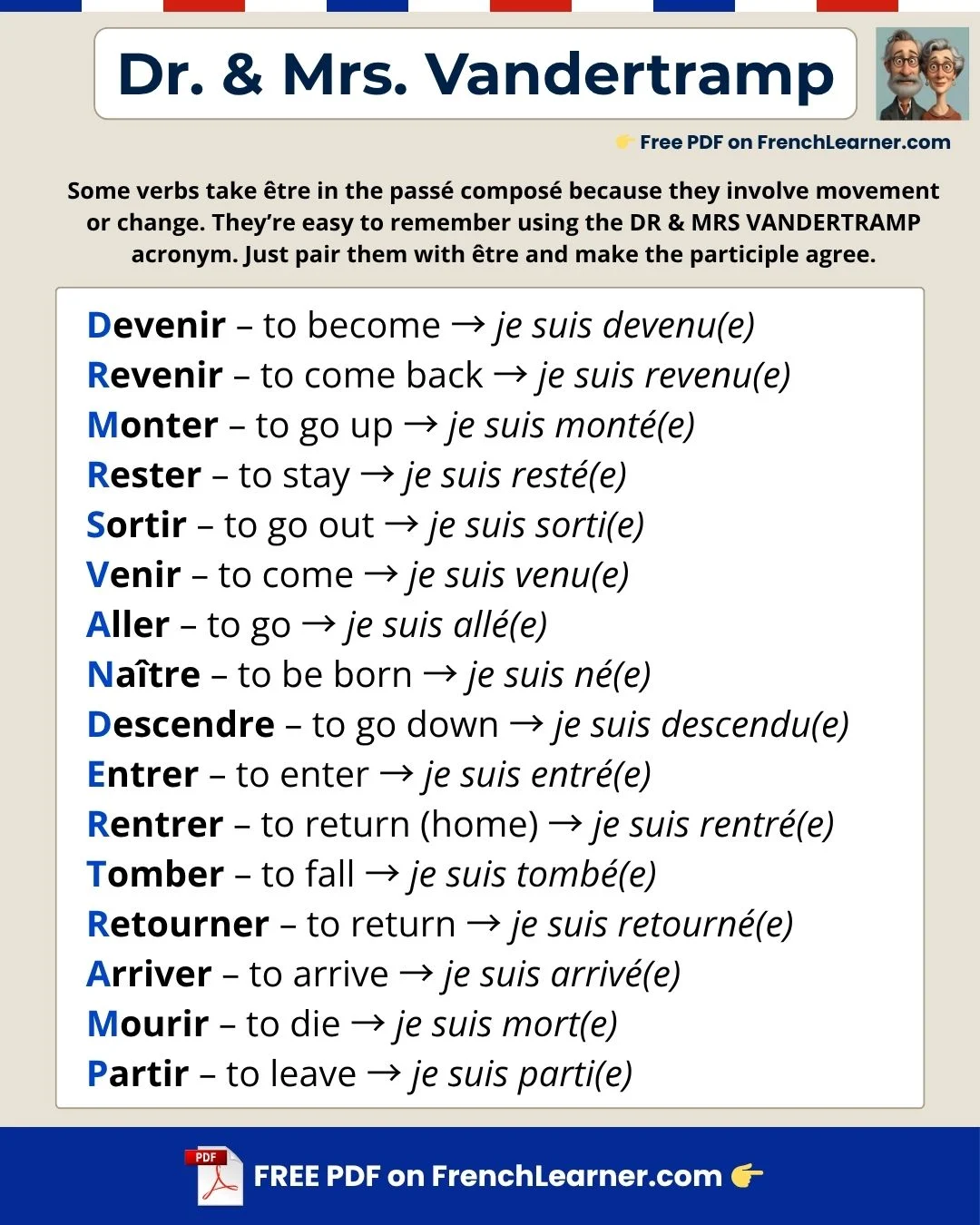
A common way to remember these verbs is the mnemonic Dr. & Mrs. Vandertramp, where each letter represents a verb that takes être in the passé composé.
The Dr. & Mrs. Vandertramp verbs
The following verbs are traditionally remembered using the Dr. & Mrs. Vandertramp acronym.
👉 Devenir – to become → je suis devenu(e)
👉 Revenir – to come back → je suis revenu(e)
👉 Monter – to go up → je suis monté(e)
👉 Rester – to stay → je suis resté(e)
👉 Sortir – to go out → je suis sorti(e)
👉 Venir – to come → je suis venu(e)
👉 Aller – to go → je suis allé(e)
👉 Naître – to be born → je suis né(e)
👉 Descendre – to go down → je suis descendu(e)
👉 Entrer – to enter → je suis entré(e)
👉 Rentrer – to return home → je suis rentré(e)
👉 Tomber – to fall → je suis tombé(e)
👉 Retourner – to return → je suis retourné(e)
👉 Arriver – to arrive → je suis arrivé(e)
👉 Mourir – to die → je suis mort(e)
👉 Partir – to leave → je suis parti(e)
Many teachers also include passer, which may use être when it means “to pass by”.
Example:
👉 Je suis passé par la poste. I went by the post office.
Conjugating être in the present tense
Because these verbs use être as the auxiliary verb, you must know the present tense conjugation of être.
Être (to be)
Je suis
Tu es
Il / elle / on est
Nous sommes
Vous êtes
Ils / elles sont
To form the passé composé, combine this conjugation with the past participle of the main verb.
Example with arriver:
👉 Je suis arrivé. I arrived.
👉 Nous sommes arrivés. We arrived.
👉 View my complete être conjugation chart with audio.
Past participle agreement with être
When verbs use être in the passé composé, the past participle must agree with the subject.
Agreement endings:
-e → feminine
-s → plural
-es → feminine plural
Examples:
👉 Je suis allé. masculine singular
👉 Je suis allée. feminine singular
👉 Nous sommes allés. masculine plural
👉 Nous sommes allées. feminine plural
Example sentences:
👉 Elle est descendue il y a quelques minutes. She came down a few minutes ago.
👉 Nous sommes arrivés tard. We arrived late.
👉 Mon fils est né samedi dernier. My son was born last Saturday.
Reflexive verbs in the passé composé
Reflexive verbs also use être as the auxiliary verb in the passé composé.
Examples:
👉 Je me suis levé. I got up.
👉 Elle s’est réveillée tôt. She woke up early.
👉 Nous nous sommes rencontrés. We met each other.
Because reflexive verbs use être, the past participle may also agree with the subject.
Verbs that can use both être and avoir
Some verbs can use either être or avoir depending on whether the verb has a direct object.
Example: sortir
👉 Je suis sorti. I went out.
👉 J’ai sorti la poubelle. I took out the trash.
Example: monter
👉 Je suis monté. I went up.
👉 J’ai monté la valise. I carried the suitcase up.
Example: descendre
👉 Je suis descendu. I went down.
👉 J’ai descendu la boîte. I brought the box down.
Example: passer
👉 Je suis passé par la banque. I went by the bank.
👉 J’ai passé trois ans en France. I spent three years in France.
🗂️ French Être Verbs in the Passé Composé Reference Card
Save this visual list for your future reference — it’s a quick guide to the French être verbs in the passé composé.
Summary
Most French verbs form the passé composé with avoir, but a small group of verbs use être. These verbs are commonly remembered using the Dr. & Mrs. Vandertramp mnemonic.
When a verb uses être, the past participle must agree with the subject in gender and number.
Learning these verbs is an essential step in mastering the French passé composé.
❓ Want to feel more confident in French?
🎯 À Moi Paris — This is my top recommendation for online French courses, and it pairs wonderfully with my daily lessons. Camille Chevalier teaches with engaging audio stories that she records at three speeds. Her specialty is helping students with pronunciation and bridging the gap between textbook French and real spoken French as you hear it on the streets of Paris.
👉 Explore À Moi Paris »
👉 Read my review »
🎧 French Verb Drills — Having trouble with French verb conjugations? Camille’s audio drills break everything down step by step so you can finally lock in the patterns and speak with confidence.
If you purchase the courses, I may earn a small commission — at no extra cost to you.
📚 Related French grammar lessons
👉 French grammar hub »
👉 Passé composé (past tense) »
👉 Past participles »
👉 Future tense (futur simple) »
👉 Imperfect tense (imparfait) »
👉 Conditional tense (conditionnel) »
👉 Subjunctive mood (subjonctif) »
👉 French verb conjugations guide »


