
Published May 17, 2026 — This collection of lessons was created by David Issokson, a McGill graduate and French teacher since 2014. Each lesson explains common words or expressions with clear explanations and real-life examples. All of the audio was recorded by Marie Assel Cambier, a native French speaker and professional voice artist.
French speakers use many short expressions to agree, disagree, react, contradict somebody, or add clarification in conversation. This lesson covers some of the most common French expressions for agreeing and disagreeing, with clear English translations and example sentences. Each linked lesson also includes FrenchLearner’s exclusive native French audio.
👍 Expressions for agreeing
D’accord — Okay, agreed
D’accord is one of the most common ways to agree in French.
➞ On se voit à huit heures ?
Shall we meet at eight?
➞ D’accord !
Okay!
Je suis d’accord — I agree
Use je suis d’accord to clearly express agreement with somebody’s opinion.
➞ Je suis d’accord avec toi.
I agree with you.
➞ Je suis tout à fait d’accord.
I completely agree.
👉 See je suis d’accord »
Absolument — Absolutely
Absolument expresses strong agreement.
➞ Tu veux voir ce film ?
Do you want to watch this movie?
➞ Absolument !
Absolutely!
👉 See absolument »
Bien sûr — Of course
Bien sûr means “of course” and is extremely common in spoken French.
➞ Tu peux m’aider ?
Can you help me?
➞ Bien sûr !
Of course!
Tout à fait — Exactly, absolutely
Tout à fait is often used to strongly confirm what somebody has said.
➞ Ce restaurant est excellent.
This restaurant is excellent.
➞ Tout à fait.
Exactly.
👉 See tout à fait »
Exactement — Exactly
➞ C’est ce que je pensais.
That’s what I was thinking.
➞ Exactement !
Exactly!
👉 See exactement »
Moi aussi — Me too
Use moi aussi to agree with a positive statement.
➞ J’adore Paris.
I love Paris.
➞ Moi aussi !
Me too!
Moi non plus — Me neither
Use moi non plus to agree with a negative statement.
➞ Je n’aime pas ce plat.
I don’t like this dish.
➞ Moi non plus.
Me neither.
👎 Expressions for disagreeing
Pas du tout — Not at all
Pas du tout strongly disagrees with a statement or answers “not at all.”
➞ Tu es fatigué ?
Are you tired?
➞ Pas du tout.
Not at all.
Je pense que non — I don’t think so
➞ Tu crois qu’il va pleuvoir ?
Do you think it’s going to rain?
➞ Je pense que non.
I don’t think so.
Pas vraiment — Not really
Pas vraiment softens disagreement.
➞ Tu as aimé le film ?
Did you like the movie?
➞ Pas vraiment.
Not really.
Au contraire — On the contrary
Au contraire directly contradicts what somebody has said.
➞ Tu n’aimes pas cette ville ?
You don’t like this city?
➞ Au contraire, je l’adore.
On the contrary, I love it.
🔄 Contradicting a negative statement with “si”
French uses si (instead of oui for yes) to contradict a negative statement. English does not have an exact equivalent.
➞ Tu ne parles pas français.
You don’t speak French.
➞ Si, je parle français.
Yes, I do speak French.
➞ Tu n’as jamais visité Paris ?
You’ve never visited Paris?
➞ Si, deux fois.
Yes, I have — twice.
👉 See si »
💬 Expressions used to clarify or correct somebody
En fait — Actually, in fact
En fait is often used to clarify, explain, or correct information.
➞ En fait, il habite à Lyon maintenant.
Actually, he lives in Lyon now.
En réalité — In reality, actually
En réalité is slightly more formal than en fait.
➞ En réalité, ce n’est pas très compliqué.
In reality, it’s not very complicated.
👉 See en réalité »
Justement — Exactly, precisely
Justement often means “exactly” or “that’s precisely the point.”
➞ C’est justement ce que je voulais dire.
That’s exactly what I wanted to say.
😊 Casual conversational reactions
C’est vrai — That’s true
➞ Paris est magnifique au printemps.
Paris is beautiful in the spring.
➞ C’est vrai.
That’s true.
👉 See c’est vrai »
Évidemment — Obviously, of course
➞ Évidemment qu’il va venir.
Of course he’s going to come.
👉 See évidemment »
Ça dépend — It depends
➞ Tu aimes habiter en ville ?
Do you like living in the city?
➞ Ça dépend.
It depends.
👉 See ça dépend »
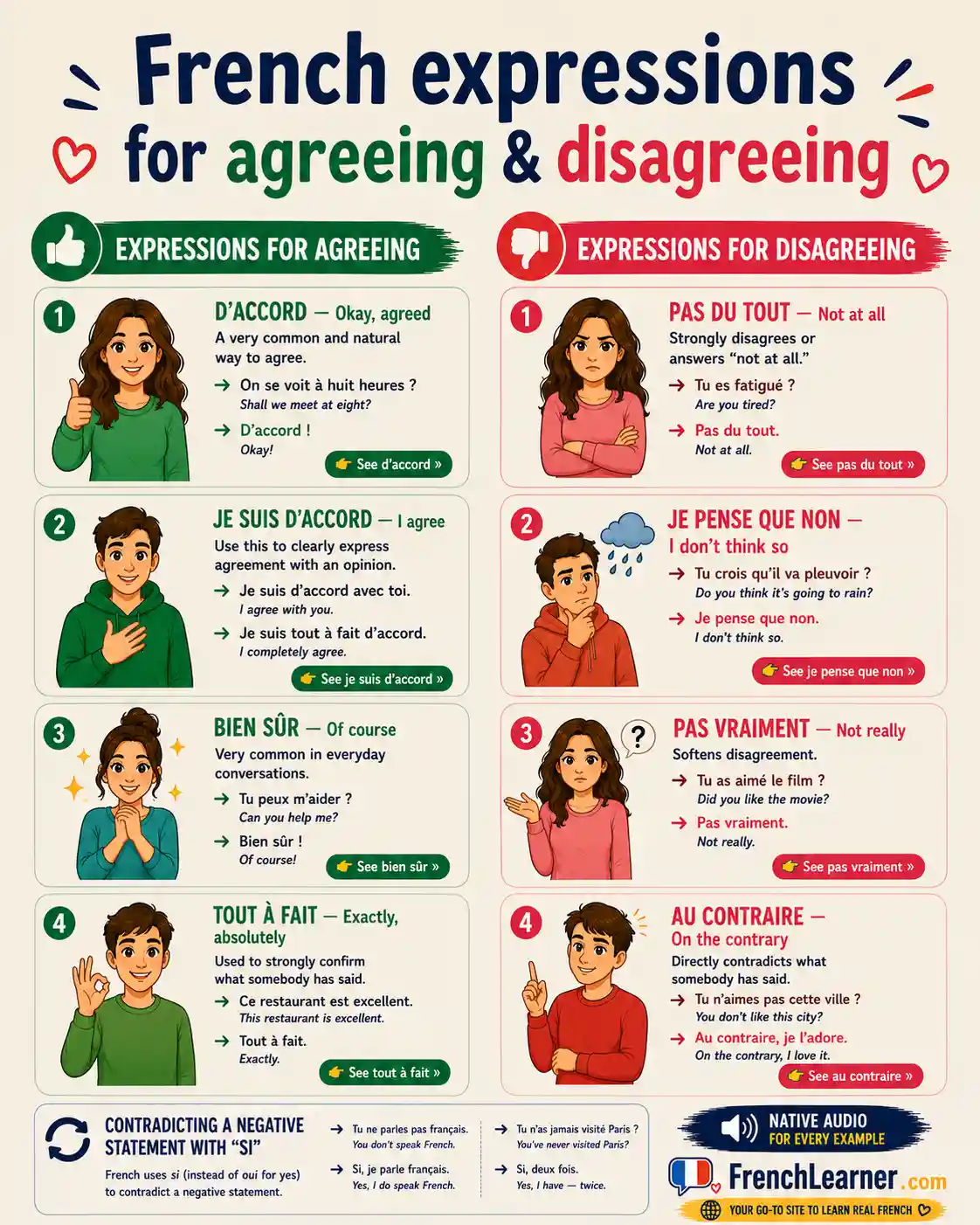
🗂️ Expressions for agreeing and disagreeing reference card
Save this list of common expressions for agreeing and disagreeing for quick reference and daily practice.
❓ Looking for more learning resources?
🎯 À Moi Paris — My top recommended course by Camille Chevalier, featuring engaging audio stories (three speeds) to help you understand real spoken French and improve pronunciation.
👉 Explore À Moi Paris »
👉 Read my review »
🎧 French Verb Drills — Camille’s step-by-step audio drills help you finally master verb conjugations.
👉 See Verb Drills »
If you purchase the courses, I may earn a small commission — at no extra cost to you.
📚 Related lessons
👉 French filler words »
👉 French connector words »
👉 French false cognates »
👉 French interjections »
🚀 Continue learning on FrenchLearner!
👉 French Word of the Day (200+ lessons) »
👉 French verb conjugations »
👉 French vocabulary lists »


