

👉 Newest lesson: l’addition (check, bill) – Published April 5, 2026
Published February 20, 2026 — Lessons written by French teacher David Issokson for students who want to learn French online. The linked lessons include native-speaker audio recorded by Marie Assel Cambier, a voice artist from France.
French and English share thousands of similar-looking words. That’s helpful — but it can also be dangerous. Some words look familiar yet mean something completely different. These are called “false friends” or faux amis in French, and they’re one of the main reasons learners accidentally say the wrong thing.
For example, actuellement does not mean “actually” — it means “currently.” Likewise, the verb assister à means “to attend,” not “to assist,” and la librairie refers to a bookstore, not a library. These small misunderstandings can completely change what you’re trying to say.
In this lesson, you’ll find the most common French false cognates grouped by theme — everyday conversation, emotions, travel, school, and more — so you can avoid common mistakes and speak with confidence.
Most Common French False Cognates (Faux Amis) Learners Confuse
🗣️ Everyday conversation mistakes
- actuellement – currently (not actually)
- éventuellement – possibly / maybe (not eventually)
- assister à – to attend (not assist)
- attendre – to wait (not attend)
- demander – to ask (not demand)
- rester – to stay (not rest)
- sensible – sensitive (not sensible)
- car – because / for (not a vehicle/car)
- l’addition – restaurant bill/check (also means addition in math)
- ignorer – To be unaware of (not to “ignore” someone intentionally)
👤 Personality & behavior
- le caractère – personality/temperament (not character in a story)
- sympathique – nice/pleasant (not sympathetic)
- pathétique – moving, touching (also means pathetic)
- grave – serious (not grave/tomb)
- curieux/curieuse – strange/odd (not only curious)
- blesser – to injure (not to bless)
- injurier – to insult (not to injure)
- prétendre – to claim (not to pretend)
- la déception – disappointment (not deception)
- l’envie (f.) – desire / “to feel like” (not envy/jealousy—use la jalousie)
🍽️ Confusing food names
- le filet mignon – pork tenderloin
- le pain – bread (not pain)
- le raisin – grape (not raisin/dried grape)
- l’entrée (f.) – starter / appetizer (not main course)
- le plat – dish/course (not plate)
- la prune – plum (not prune/dried plum)
- la recette – recipe (not receipt)
🧭 Places & everyday surroundings
- la librairie – bookstore (not library)
- la location – rental (not location)
- le coin – corner (not coin money)
- la terrasse – outdoor seating area (not terrace always)
- l’hôtel de ville (m.) – city hall/town hall (not a hotel)
- la monnaie – change/coins (not money in general)
- la cave – basement/cellar (not a cave/cavern)
🏫 School & academic life
- le collège – middle school (not college)
- le lycée – high school (not university/college)
- le stage – internship (not stage theater)
- la formation – training/course (not formation shape)
- la lecture – reading (not lecture speech)
- la note – grade/mark (not just written note)
- la réunion – meeting (not reunion party)
💼 Work & practical life
- le délai – deadline/time limit (not delay verb)
- l’avis – opinion (not advice)
- complet – full (not complete finished)
- l’occasion (f.) – opportunity (not special occasion only)
- soutenir – to support/defend academically (not sustain physically)
- bosser – to work hard
😬 Embarrassing mistakes
- le préservatif – condom (not preservative)
- excité – aroused (not excited generally)
- propre – clean (not proper)
- introduire – to insert (not to “introduce” — use présenter)
- la journée – the day as a duration (not journey)
🇫🇷 Struggling to sound more fluent?
I’ve known French Teacher Camille from French Today since 2014 and highly recommend her course À Moi Paris. Through engaging audio stories recorded at three speeds — slow, medium, and fast — she guides students from beginner level all the way to fluency while building real-world confidence along the way.
👉 Try the course »
👉 Read my review »
If you purchase a course, I may earn a small commission — at no extra cost to you.
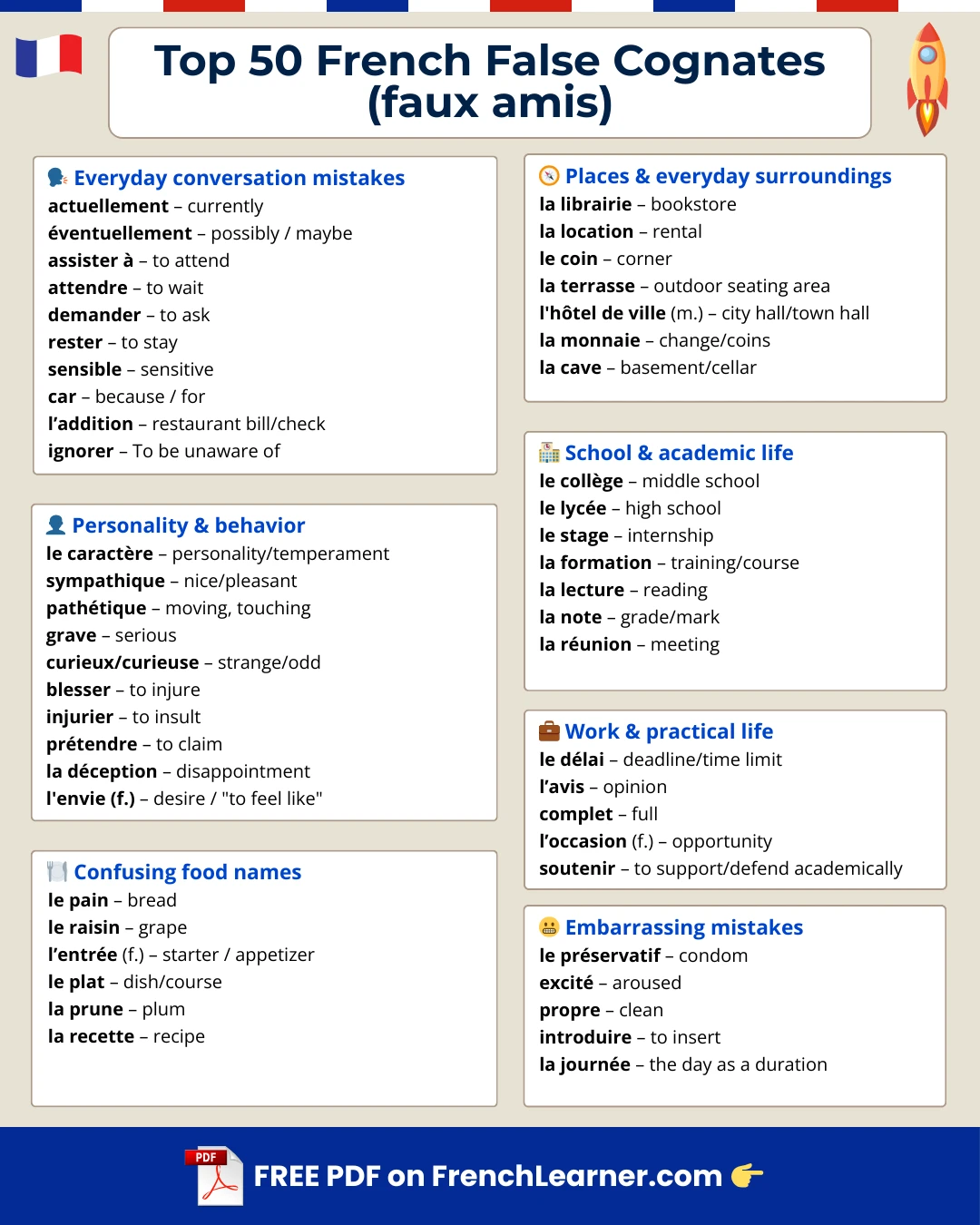
🗂️ French False Cognates Reference Card
Save this visual list for your future reference — it’s a quick guide to the most useful French false cognates and their meanings.
🚀 Continue growing your French vocabulary and fluency!
👉 Main French vocabulary hub »
👉 French Word of the Day »
👉 French filler words »
👉 French connector words »
👉 French interjections and exclamations »
👉 French Christmas lessons hub »
French False Cognates (Faux Amis) — Frequently Asked Questions (FAQ)
What is a French false cognate (faux ami)?
A false cognate is a French word that looks similar to an English word but has a different meaning, such as actuellement (currently) or assister à (to attend).
Why are false cognates important to learn?
They cause many of the most common learner mistakes. Knowing them helps you avoid misunderstandings and speak more accurately.
Are false cognates difficult for beginners?
Not really. Many appear at A1–A2 level. Learning the most frequent ones early prevents bad habits later.
What’s the difference between a cognate and a false cognate?
A cognate has the same meaning in both languages (important = important). A false cognate only looks similar but means something different (sensible = sensitive).


