
Published September 11, 2012 • Updated June 24, 2026 — By French teacher David Issokson, teaching French online since 2014
French sentence structure is usually similar to English: subject + verb + complement. For example, Je parle français means “I speak French.” However, French has some important word order rules that are different from English. In this lesson, you will learn how to build basic French sentences, ask questions, make sentences negative, place pronouns correctly, and avoid common mistakes.
Free PDF: French Grammar Made Easy Cheat Sheet
✅ Basic French sentence order
✅ Negative sentences
✅ Questions
✅ Object pronouns
✅ Adjective placement
✅ Adverb placement
✅ Common sentence patterns
✅ Common mistakes
Basic French sentence order
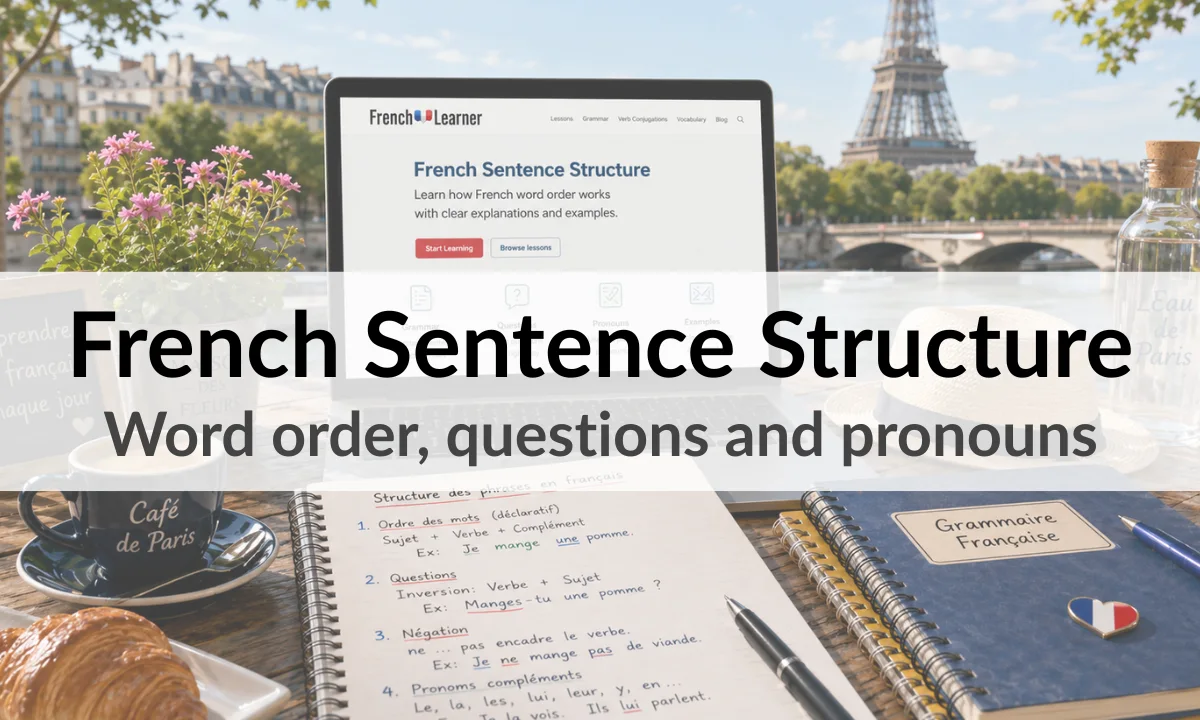
The most basic French sentence structure is:
subject + verb + complement
This is similar to English word order.
Je parle français.
I speak French.
Elle habite à Paris.
She lives in Paris.
Nous aimons cette leçon.
We like this lesson.
In French, the subject usually cannot be omitted. This means that subject pronouns such as je, tu, il, elle, nous, and vous are normally required before the verb.
Tu comprends la phrase.
You understand the sentence.
Ils regardent le film.
They are watching the movie.
The main exception is the imperative, which is used for commands.
Parle français !
Speak French!
Écoutez la phrase !
Listen to the sentence!
Negative sentences
To make a French sentence negative, place ne before the conjugated verb and pas after it.
subject + ne + verb + pas + complement
Je ne parle pas espagnol.
I do not speak Spanish.
Tu ne comprends pas la question.
You do not understand the question.
Before a vowel or silent h, ne becomes n’.
Je n’aime pas ce livre.
I do not like this book.
Elle n’habite pas ici.
She does not live here.
Other common negative structures follow the same basic pattern.
Je ne travaille jamais le dimanche.
I never work on Sundays.
Je ne comprends rien.
I do not understand anything.
Je ne connais personne ici.
I do not know anyone here.
Questions
French has three main ways to ask yes-or-no questions.
The easiest way is to use rising intonation. The word order stays the same as a regular sentence.
Tu parles français ?
Do you speak French?
Vous habitez à Paris ?
Do you live in Paris?
A more standard way is to place est-ce que before the sentence.
Est-ce que tu parles français ?
Do you speak French?
Est-ce que vous comprenez ?
Do you understand?
A more formal way is inversion, where the verb and subject pronoun switch places.
Parles-tu français ?
Do you speak French?
Comprenez-vous la question ?
Do you understand the question?
Question words usually come at the beginning of the sentence.
Où habites-tu ?
Where do you live?
Pourquoi apprends-tu le français ?
Why are you learning French?
Quand partez-vous ?
When are you leaving?
Object pronouns
French object pronouns usually come before the conjugated verb. This is one of the biggest differences between French and English sentence structure.
Je vois Paul.
I see Paul.
Je le vois.
I see him.
Elle aime cette chanson.
She likes this song.
Elle l’aime.
She likes it.
Indirect object pronouns also come before the verb.
Je parle à Marie.
I am speaking to Marie.
Je lui parle.
I am speaking to her.
Nous écrivons à nos amis.
We are writing to our friends.
Nous leur écrivons.
We are writing to them.
Common French object pronouns include me, te, le, la, l’, nous, vous, les, lui, leur, y, and en.
Pronouns with infinitives
When a sentence has a conjugated verb followed by an infinitive, the object pronoun usually goes before the infinitive.
Je veux voir Paul.
I want to see Paul.
Je veux le voir.
I want to see him.
Elle va appeler ses parents.
She is going to call her parents.
Elle va les appeler.
She is going to call them.
Tu dois aller à Paris.
You have to go to Paris.
Tu dois y aller.
You have to go there.
This structure is very common with verbs such as vouloir (to want), pouvoir (to be able to, can), devoir (to have to, must), aller (to go), and aimer (to like).
Adjective placement
In French, most adjectives come after the noun.
une voiture rouge
a red car
un livre intéressant
an interesting book
une leçon importante
an important lesson
However, many short and common adjectives come before the noun.
un petit café
a small coffee / cafe
une belle maison
a beautiful house
un bon professeur
a good teacher
These often include adjectives of beauty, age, goodness, and size.
Adverb placement
French adverbs can appear in different places depending on what they modify.
With a simple verb, many adverbs come after the verb.
Il parle lentement.
He speaks slowly.
Elle travaille beaucoup.
She works a lot.
Adverbs that modify adjectives come before the adjective.
C’est très important.
It is very important.
Elle est vraiment gentille.
She is really kind.
In compound tenses, short common adverbs often come between the auxiliary verb and the past participle.
J’ai bien dormi.
I slept well.
Il a déjà mangé.
He has already eaten.
Compound tenses
In compound tenses such as the passé composé, the basic structure is:
subject + auxiliary verb + past participle
J’ai mangé.
I ate / I have eaten.
Elle est partie.
She left / She has left.
In negative sentences, ne… pas goes around the auxiliary verb.
Je n’ai pas mangé.
I did not eat.
Elle n’est pas partie.
She did not leave.
With object pronouns, the pronoun comes before the auxiliary verb.
Je l’ai vu.
I saw him / it.
Nous leur avons parlé.
We spoke to them.
Common sentence patterns
Here are some very common French sentence structures that learners should know.
Il y a
Il y a un problème.
There is a problem.
Il y a beaucoup de monde.
There are a lot of people.
👉 Il y a »
C’est
C’est important.
It is important.
C’est une bonne idée.
It is a good idea.
👉 C’est »
Il faut
Il faut étudier.
It is necessary to study.
Il faut parler français tous les jours.
You have to speak French every day.
Je voudrais
Je voudrais un café.
I would like a coffee.
Je voudrais parler français.
I would like to speak French.
Être en train de
Je suis en train de travailler.
I am working.
Elle est en train de lire.
She is reading.
Common mistakes
Putting object pronouns after the verb
Incorrect: Je vois le.
Correct: Je le vois.
I see him / it.
Putting most adjectives before the noun
Incorrect: une rouge voiture
Correct: une voiture rouge
a red car.
Forgetting ne in formal written French
Informal spoken French often drops ne, but standard written French keeps it.
Informal: Je parle pas français.
Formal: Je ne parle pas français.
I do not speak French.
Using être instead of avoir for age
Incorrect: Je suis trente ans.
Correct: J’ai trente ans.
I am thirty years old.
📚 Related lessons
- French negation rules
- French questions
- French object pronouns
- French adjectives
- French adverbs
- French subject pronouns
🚀 More lessons on FrenchLearner


