
Published March 11, 2022 • Updated March 29, 2026 — Lesson written by French teacher David Issokson for students who want to learn French online, with native audio by Marie Assel Cambier, a voice artist from France.
📘 Moi meaning
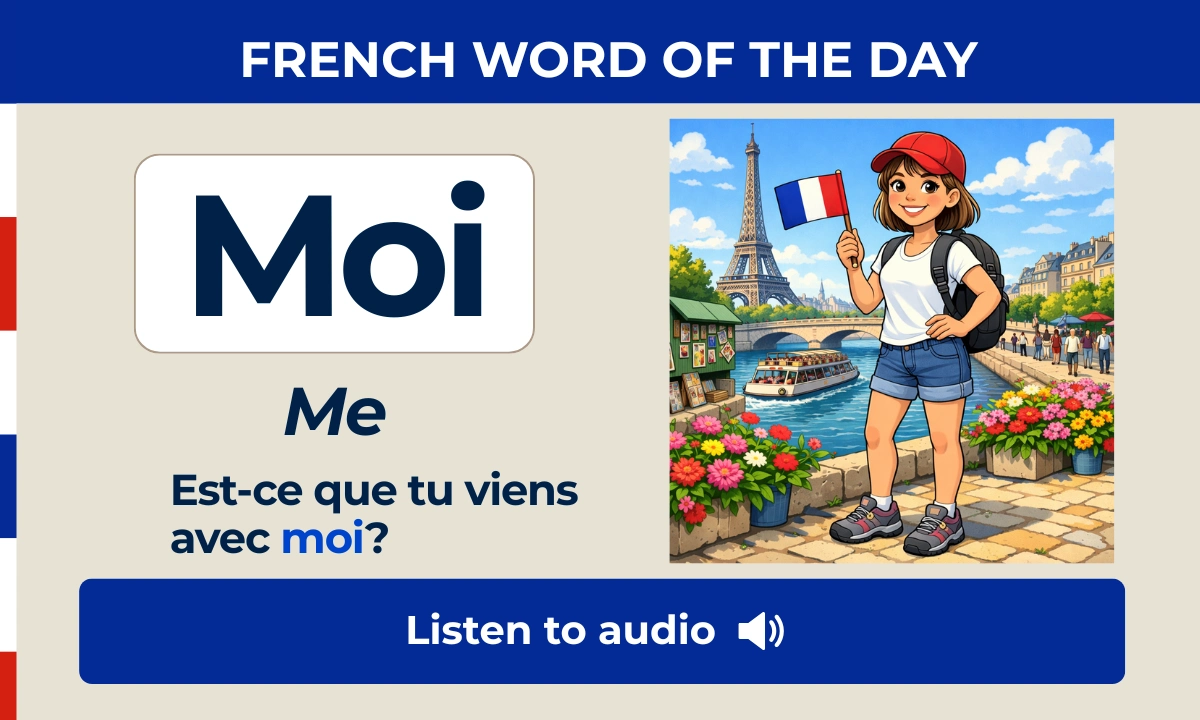
Moi means “me” in French. It’s a stressed pronoun, most often used after prepositions such as avec (with), pour (for), sans (without), contre (against), or chez (at someone’s place) — e.g. Venez avec moi (Come with me). French has another word for “me”: me (pronounced muh), which appears before the verb in sentences like Tu me vois ? (Do you see me?).
🎧 Moi pronunciation
👉 The pronunciation of moi is /mwa/ — roughly “mwah.”
📝 Moi examples
Here are example sentences showing moi used as a stressed pronoun with prepositions.
Est-ce que tu viens avec moi?
Are you coming with me?
“Moi!” can also appear standing on its own to mean “me!” For example:
Qui aime le fromage? — Moi!
Who likes cheese? — Me?
Qui veut manger de la glace? — Moi!
Who wants to eat some ice cream? — Me!
Moi can also precede the word je (I) to add some emphasis. In this context, moi can translate to both “personally” and “as for me”.
Moi, je préfère parler français!
(Personally/As for me,) I prefer speaking French!
Moi can also be used in the imperative (command) mood.
Parle-moi!
Speak to me!
Negative commands, however, use me. Here is the same example in the negative form:
Ne me parle pas!
Don’t speak to me!
Moi is a stressed pronoun. Other key stressed pronouns include toi (you), lui (him) and elle (her).
👉 See also: Stressed pronouns complete explanation »
Pronoun “me” in French — definition and meaning
The other way to say “me” in French is me (pronounced muh). In the following sentences, me functions as a direct object pronoun, meaning either “me”, “to me”, or “at me” when the verb is not followed by the preposition à.
Vous me voyez.
You see me.
In the following sentences, me is an indirect object pronoun used with verbs that take the preposition à.
Elle me parle.
She speaks to me.
⚠️ Important distinction between “me” and “moi”
To say “She speaks to me,” you cannot say “Elle parle à moi” — this is considered incorrect in French.
✅ The correct form is: “Elle me parle.”
However, not all verbs follow this pattern.
With penser (to think), you must use “moi”:
✅ “Elle pense à moi” = “She thinks about me.”
❌ “Elle me pense” is not used in French.
👉 See also : Penser (to think) examples »
❓ Want to feel more confident in French?
🎯 À Moi Paris — This is my top recommendation for online French courses, and it pairs wonderfully with my daily lessons. Camille Chevalier teaches with engaging audio stories that she records at three speeds. Her specialty is helping students with pronunciation and bridging the gap between textbook French and real spoken French as you hear it on the streets of Paris.
👉 Explore À Moi Paris »
👉 Read my review »
🎧 French Verb Drills — Having trouble with French verb conjugations? Camille’s audio drills break everything down step by step so you can finally lock in the patterns and speak with confidence.
If you purchase the courses, I may earn a small commission — at no extra cost to you.
🔗 Related words and expressions
- moi aussi — me too
- moi non plus — me neither
- pas moi ! — not me! / not I!
- moi-même — myself
- quant à moi — as for me / in my opinion
Related lessons
To say “me too” in French, you have two options: moi aussi and moi non plus.
👉 See lesson: Moi aussi vs. moi non plus explained »
I also cover quant à moi (as for me) in detail.
👉 See also: quant à meaning and examples »
🚀 Continue learning on FrenchLearner!
👉 French Word of the Day (200+ lessons) »
👉 French word meanings (common words explained clearly) »
👉 French vocabulary lists »


