

Published May 9, 2022 · Updated May 25, 2026 — Lesson written by French teacher David Issokson. Pronunciation audio recorded by Marie Assel Cambier, a professional voice artist and native French speaker. Lyrics provided for educational purposes to support French language learning. All rights belong to the original copyright holders.
Sous le ciel de Paris (Under the Paris sky) is one of the most iconic French chansons ever written. First composed for the 1951 film of the same name, the song was later made famous by Édith Piaf and Yves Montand. The title means “Under the Paris Sky”, and the lyrics paint a poetic portrait of life unfolding beneath the city’s skyline.
The song is filled with useful intermediate French vocabulary and vivid Parisian imagery. Learners will encounter descriptive verbs like s’envoler (to soar), couver (to simmer), and fleurir (to bloom), along with references to real Paris landmarks such as the Pont de Bercy, Notre-Dame, and Île Saint-Louis. This makes it an excellent classic for serious French students who want to build vocabulary while exploring authentic cultural imagery.
🎙️ Listen to the song
📘 Meaning and pronunciation in French
🔊 Practice with audio
✏️ Lyrics and notes
🎙️ Listen to “Sous le ciel de Paris” by Édith Piaf
Listen to the song — how many words can you catch before checking the translation?
📘 Sous le ciel de Paris Meaning and Pronunciation
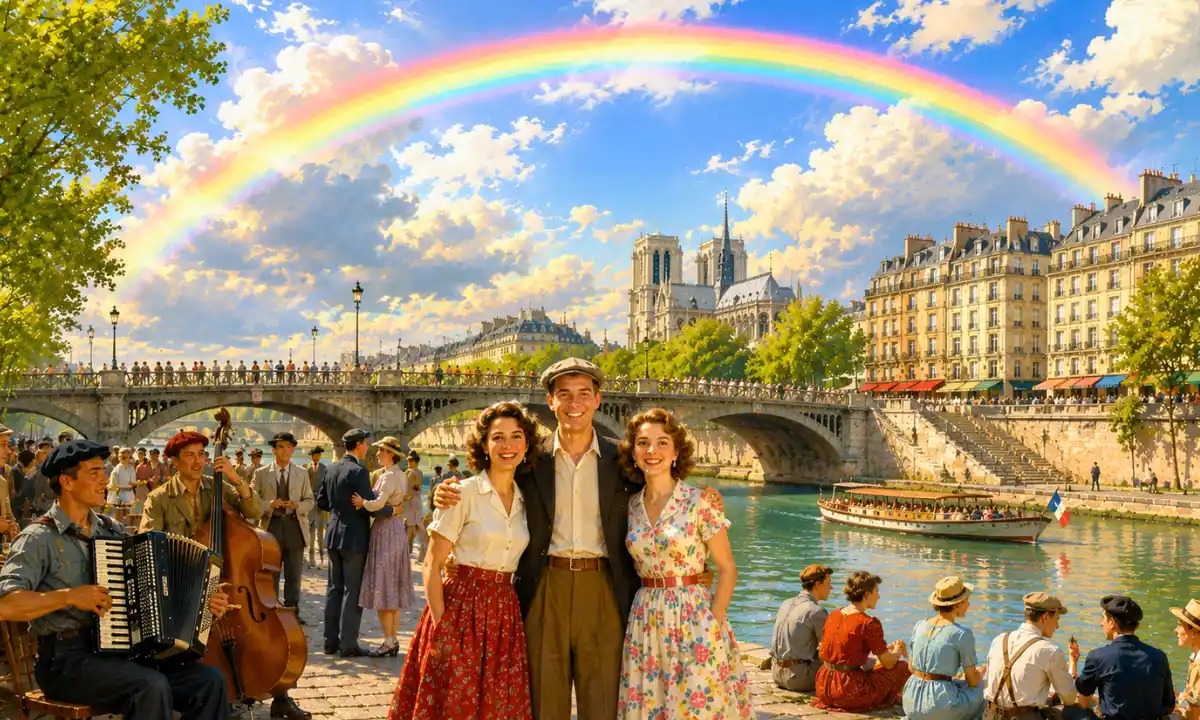
Sous le ciel de Paris means “Under the Paris sky”. In the song, this refers to all of life unfolding beneath Paris itself. The lyrics describe lovers walking, musicians playing, crowds gathering, and the Seine flowing through the city. It presents Paris as a place full of beauty, movement, and everyday human connection.
The song also gives the Paris sky human emotions. It watches over the city almost like a lover. At times it grows jealous and sends rain and thunder. Then it calms down and offers a rainbow over Paris. This poetic image suggests a deep bond between the city and the sky watching over it.
The pronunciation of Sous le ciel de Paris is /su lə sjɛl də pa.ʁi/ (IPA), which sounds roughly like “soo luh syel duh pah-ree”.
🔊 Practice pronunciation from the song
The recordings below feature key lines from the song recorded by a native French speaker for clear, natural pronunciation. Listen and repeat each line to improve your accent and rhythm.
Sous le ciel de Paris
Under the Paris sky
S’envole une chanson
A song takes flight
Marchent des amoureux
Lovers walk
Sous le pont de Bercy
Under the Bercy bridge
Jusqu’au soir vont chanter
They sing until evening
L’hymne d’un peuple épris
The anthem of a people in love
Près de Notre-Dame
Near Notre-Dame
Oui mais à Paname
Yes, but in Paris
L’accordéon
The accordion
Au ciel de Paris
In the Paris sky
Mais le ciel de Paris
But the Paris sky
N’est pas longtemps cruel
Is not cruel for long
Il offre un arc-en-ciel
It offers a rainbow
✏️ Sous le ciel de Paris lyrics and grammar notes
In this section I cover the French vocabulary, expressions, and grammar structures from Sous le ciel de Paris to help you better understand the song’s lyrics.
🎼 Song Title
Sous le ciel de Paris → literal translation: Under the sky of Paris
- Sous = under, beneath
- Le ciel = the sky
- De Paris = of Paris
- The title presents Paris as a poetic, living presence
- It introduces the song’s central image of the city watched over by its sky
🧩 Sentence Structures & Grammar
S’envole une chanson
👉 “A song takes flight”
- S’envoler (to fly away, soar) in present tense
- Verb-first inversion creates poetic emphasis
Elle est née d’aujourd’hui
👉 “It was born today”
- Naître (to be born) in passé composé with être (to be)
- D’aujourd’hui means of today, from today; See: aujourd’hui
Dans le cœur d’un garçon
👉 “In a young man’s heart”
- Dans introduces location
- le cœur = heart
- Symbolic emotional imagery
Sous le ciel de Paris
👉 “Under the Paris sky”
- Refrain reinforcing the central setting
Marchent des amoureux
👉 “Lovers walk”
- Marcher (to walk) in present tense
- Inversion gives lyrical rhythm
Leur bonheur se construit
👉 “Their happiness is being built”
- Se construire (to build itself, take shape) in reflexive present tense
- Suggests gradual formation
Sur un air fait pour eux
👉 “To a tune made for them”
- Faire (to make) in past participle
- Fait pour means made for
Sous le pont de Bercy
👉 “Under the Bercy bridge”
- Specific Paris location adds realism
Un philosophe assis
👉 “A seated philosopher”
- Asseoir (to seat) in past participle form assis
Deux musiciens, quelques badauds
👉 “Two musicians, a few onlookers”
- Quelques means a few
- Badaud refers to a curious passerby
Puis les gens par milliers
👉 “Then people by the thousands”
- Puis = then
- Par milliers expresses large quantity
Jusqu’au soir vont chanter
👉 “They sing until evening”
- Chanter (to sing) after aller (to go) + infinitive (near future tense)
- Jusqu’à means until
L’hymne d’un peuple épris
👉 “The anthem of a people in love”
- Éprendre (to inspire love) in adjective form épris
De sa vieille cité
👉 “Of its old city”
- Vieille cité is poetic for old city
Près de Notre-Dame
👉 “Near Notre-Dame”
- Près de = near
- Naming a real Paris landmark for realism
Parfois couve un drame
👉 “Sometimes a drama is brewing”
- Parois = sometimes occasionally
- Couver (to incubate, simmer) used figuratively
Oui, mais à Paname
👉 “Yes, but in Paris”
- Paname is affectionate slang for Paris
Tout peut s’arranger
👉 “Everything can work out”
- S’arranger (to work itself out, be resolved) in infinitive
Quelques rayons du ciel d’été
👉 “A few rays from the summer sky”
- Rayon means ray, beam of light
L’accordéon d’un marinier
👉 “A boatman’s accordion”
- Evokes traditional Paris riverside life
L’espoir fleurit
👉 “Hope blooms”
- Fleurir (to bloom, flourish) in present tense
Au ciel de Paris
👉 “In the Paris sky”
- Returns to symbolic imagery
Sous le ciel de Paris
👉 “Under the Paris sky”
- Repetition creates musical continuity
Coule un fleuve joyeux
👉 “A joyful river flows”
- Couler (to flow) in present tense
- Le fleuve (river) refers to the Seine River
Il endort dans la nuit
👉 “It lulls to sleep in the night”
- Endormir (to put to sleep) in present tense
Les clochards et les gueux
👉 “The homeless and the poor”
- Social imagery of Paris nightlife
Les oiseaux du Bon Dieu
👉 “The good Lord’s birds”
- Metaphorical image of visitors and travelers
Viennent du monde entier
👉 “Come from the whole world”
- Venir (to come) in present tense
Pour bavarder entre eux
👉 “To chat among themselves”
- Bavarder (to chat) infinitive of purpose
Et le ciel de Paris
👉 “And the Paris sky”
- Continues personification
A son secret pour lui
👉 “Has its secret for itself”
- Lui is a stressed pronoun meaning both him and her
- Possessive poetic construction
Depuis vingt siècles
👉 “For twenty centuries”
- Depuis (since, for) expresses ongoing duration
Il est épris de notre Île Saint-Louis
👉 “It is in love with our Île Saint-Louis”
- Être épris de means to be deeply in love with
- Again, mention of real places
Quand elle lui sourit
👉 “When she smiles at it”
- Sourire (to smile) in present tense
Il met son habit bleu
👉 “It puts on its blue attire”
- Mettre (to put on) in present tense
Quand il pleut sur Paris
👉 “When it rains over Paris”
- Il pleut (it rains) impersonal weather verb
C’est qu’il est malheureux
👉 “It is because it is unhappy”
- C’est que introduces explanation
Quand il est trop jaloux
👉 “When it is too jealous”
- Emotional personification of the sky
De ses millions d’amants
👉 “Of its millions of lovers”
- Amant = lover
Il fait gronder sur eux
👉 “It makes thunder rumble over them”
- Faire (to make) + infinitive causative structure
- Gronder (to rumble) infinitive
Son tonnerre éclatant
👉 “Its crashing thunder”
- Éclater (to burst) in adjective form éclatant
Mais le ciel de Paris
👉 “But the Paris sky”
- Mais = but
- Introduces contrast
N’est pas longtemps cruel
👉 “Is not cruel for long”
- Longtemps indicates duration
Pour se faire pardonner
👉 “To make itself forgiven”
- Se faire pardonner (to make amends, seek forgiveness)
Il offre un arc-en-ciel
👉 “It offers a rainbow”
- Offrir (to offer) in present tense
- Final symbol of reconciliation
🔤 Verb Forms & Tenses
- Present tense: s’envole, marchent, coule, fleurit, pleut
- Passé composé: est née from naître (to be born)
- Reflexive infinitives: s’arranger (to work out), se faire pardonner (to seek forgiveness)
- Causative structure: faire gronder (to make rumble)
- Duration structure: depuis vingt siècles
- Frequent personification through active verb choice
💬 Idioms & Natural Expressions
- Être épris de → to be deeply in love with
- Tout peut s’arranger → everything can work out
- Faire gronder → to make rumble
- Se faire pardonner → to make amends
- Bon Dieu → Good Lord
📘 Vocabulary
- le ciel — sky
- une chanson — song
- le cœur — heart
- un amoureux — lover
- le bonheur — happiness
- un air — melody
- un badaud — passerby
- un hymne — anthem
- un peuple — people
- une cité — city
- un rayon — ray
- l’accordéon — accordion
- l’espoir — hope
- un fleuve — river
- un clochard — homeless person
- un gueux — pauper
- un secret — secret
- un habit — outfit
- le tonnerre — thunder
- un arc-en-ciel — rainbow
🎶 Take your learning to the next level!
FrenchLearner offers one of the largest collections of French song lessons online. Visit the French song lyrics hub to explore classics from the 1950s to the 2000s.
🎵 More Édith Paif songs you’ll love
👉 La Vie en rose »
👉 Non, je ne regrette rien »
👉 L’Hymne à l’amour »
👉 Milord »
👉 Padam, Padam »
👉 Mon Dieu »
👉 La Foule »
🇫🇷 More French classic songs you’ll love
👉 La Bohème »
👉 Ne me quitte pas (Jacques Brel) »
👉 Les feuilles mortes (Yves Montand) »
👉 La mer (Charles Trenet) »
About this lesson: I create these song-based lessons to help French learners improve vocabulary, grammar, and cultural understanding in a fun, engaging way. Song lyrics are provided for educational purposes under fair use. All rights to the original works belong to their respective copyright holders.


