
Published May 13, 2020 • Updated June 11, 2026 — By French teacher David Issokson, teaching French online since 2014
French stressed pronouns (also called disjunctive or emphatic pronouns) are used to emphasize a person, follow prepositions, make comparisons, answer questions by themselves, and appear in expressions such as moi aussi (me too) and c’est moi (it’s me). They usually refer to people and often correspond to English pronouns such as me, you, him, her, us, and them.
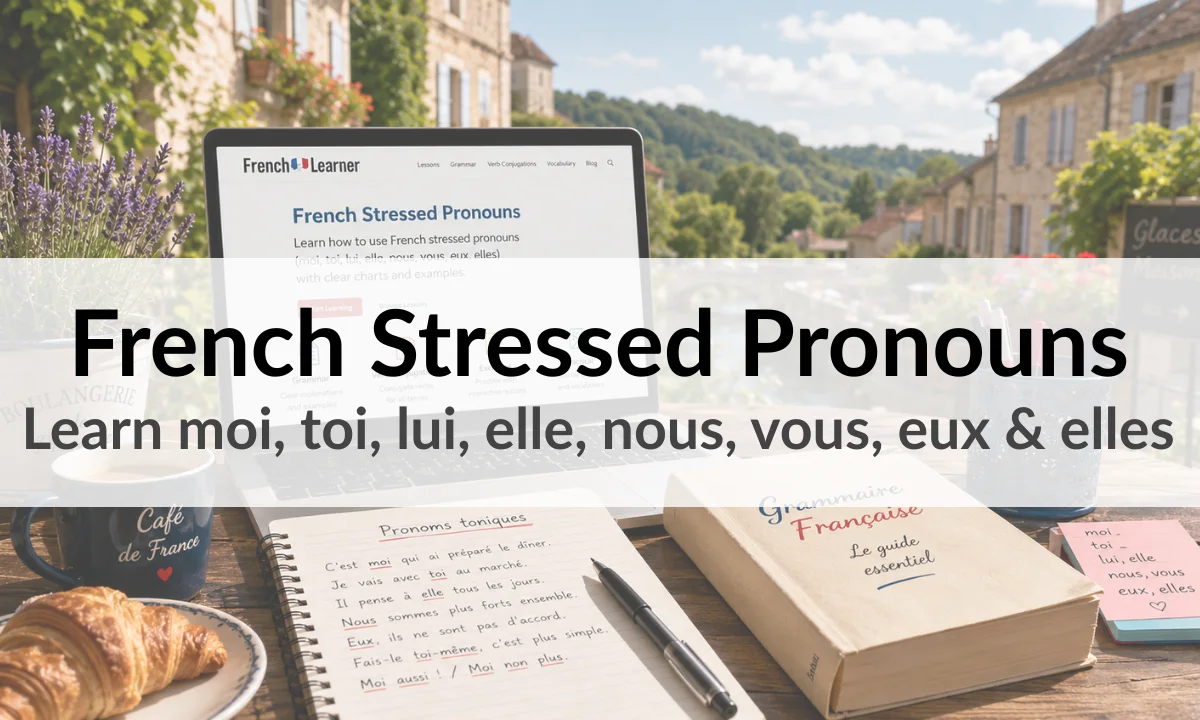
French stressed pronoun chart
French has eight stressed pronouns that correspond to English pronouns like me, you, him, and them. The chart below shows each stressed pronoun alongside its matching subject pronoun and English meaning for quick reference.
| Subject pronoun | Stressed pronoun | English |
|---|---|---|
| je | moi | me |
| tu | toi | you |
| il | lui | him |
| elle | elle | her |
| nous | nous | us |
| vous | vous | you |
| ils | eux | them |
| elles | elles | them |
When to use stressed pronouns
French stressed pronouns have several common uses, including adding emphasis, following prepositions, making comparisons, and answering questions by themselves.
| Situation | Example | Meaning |
|---|---|---|
| Emphasis | Moi, je préfère le café. | Me, I prefer coffee. |
| After c’est / ce sont | C’est lui qui conduit. | He’s the one driving. |
| After a preposition | Je travaille avec elle. | I work with her. |
| In comparisons | Il est plus grand que moi. | He’s taller than me. |
| Stand-alone answer | Qui vient ? Moi ! | Who’s coming? Me! |
| Moi aussi / Moi non plus | Moi aussi ! | Me too! |
| With -même | Fais-le toi-même. | Do it yourself. |
| With another noun or pronoun | Paul et moi | Paul and I |
Emphasis
Use a stressed pronoun to put extra emphasis on a person.
Moi, je n’aime pas les petits pois.
I don’t like peas.
Lui, il adore le chocolat.
He loves chocolate.
After c’est and ce sont
Stressed pronouns commonly follow c’est and ce sont.
C’est moi qui parle français ici.
I’m the one who speaks French here.
Ce sont eux qui préparent le repas.
They’re the ones preparing the meal.
With another noun or pronoun
Stressed pronouns are used when joining people with et, ou, or ni (neither).
Ma sœur et moi allons au cinéma.
My sister and I are going to the movies.
Lui et Sylvie habitent à Lyon.
He and Sylvie live in Lyon.
Ni toi ni lui n’avez répondu.
Neither you nor he replied.
After prepositions
Use stressed pronouns after prepositions such as avec, pour, sans, chez, and contre.
Je travaille pour lui.
I work for him.
Il habite avec moi.
He lives with me.
Je n’irai pas sans eux.
I won’t go without them.
Je dîne chez elle ce soir.
I’m having dinner at her place tonight.
Stand-alone expressions
Stressed pronouns can stand on their own.
Qui a gagné ? Moi !
Who won? Me!
Elle aime le ski. Moi aussi !
She likes skiing. Me too!
Il ne veut pas venir. Moi non plus !
He doesn’t want to come. Me neither!
Comparisons
After que in comparisons, use a stressed pronoun.
Il est plus grand que moi.
He’s taller than me.
Elle est aussi rapide que lui.
She’s as fast as him.
Je suis moins occupé que toi.
I’m less busy than you.
With -même
Add -même to express myself, yourself, himself, and so on.
J’ai réparé mon vélo moi-même.
I repaired my bike myself.
Fais-le toi-même !
Do it yourself!
Ils ont construit la cabane eux-mêmes.
They built the cabin themselves.
After certain verbs
Some verbs are followed by à or de, so the person is expressed with a stressed pronoun.
Je pense à lui.
I’m thinking about him.
Elle songe à eux.
She’s thinking about them.
J’ai besoin d’elle.
I need her.
Common mistake
Don’t use a subject pronoun after a preposition.
❌ Je dîne avec il.
✅ Je dîne avec lui.
Likewise:
❌ Je travaille pour ils.
✅ Je travaille pour eux.
Summary table
As you’ve just seen, stressed pronouns are used in several common situations, from adding emphasis to following prepositions and making comparisons. The summary table below provides a quick overview of their main uses with example sentences.
| Use | Example | English |
|---|---|---|
| Emphasis | Moi, je préfère partir. | Me, I’d rather leave. |
| After c’est | C’est nous. | It’s us. |
| With another noun | Marie et moi | Marie and I |
| After prepositions | avec lui | with him |
| Comparisons | plus grand que moi | taller than me |
| Stand-alone reply | Moi ! | Me! |
| Moi aussi | Moi aussi ! | Me too! |
| With -même | toi-même | yourself |
| After verbs with à/de | penser à elle | to think about her |
📚 Related lessons
🚀 More lessons on FrenchLearner


