
Published May 17, 2024 • Updated April 28, 2026 — Lesson written by French teacher David Issokson • Native Audio by Marie Assel Cambier
Il y a, meaning “there is”, “there are”, and “ago”, is one of the most useful and most frequently used expressions in French. Learn to use it naturally with Marie’s audio examples below.
Key usages:
✅ There is, there are
✅ Ago
✅ Weather
✅ Different tenses
📘 Il y a meaning
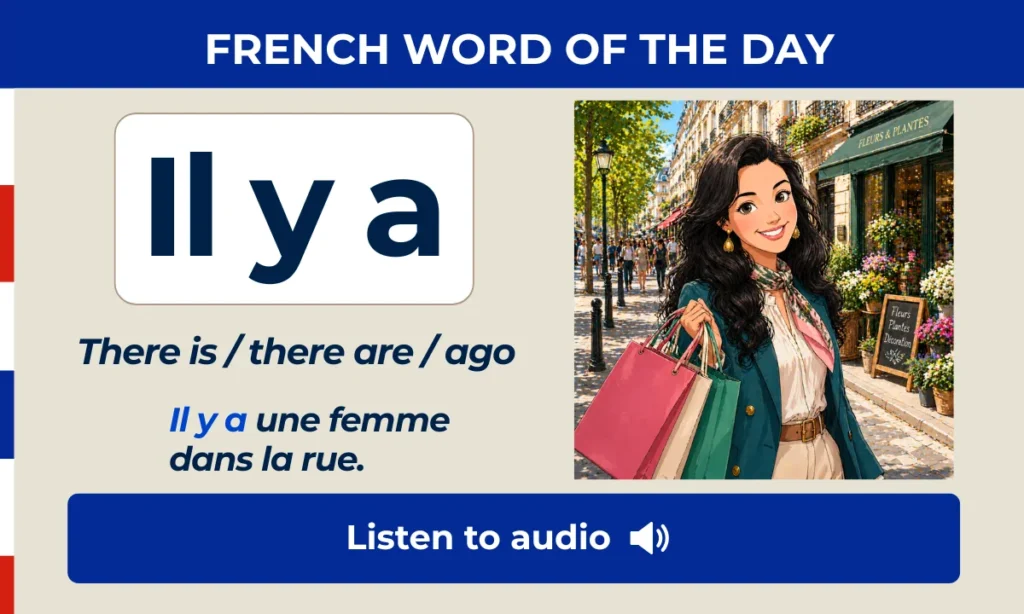
Il y a is a common impersonal French expression meaning “there is”, “there are”, or “ago” depending on context. Use it to talk about the existence of something or when something happened in the past. It is one of the most useful everyday expressions in French.
🎧 Il y a pronunciation
The pronunciation of il y a is /il j‿a/ (IPA), which sounds roughly like “eel yah”.
📝 Il y a examples
There is, there are
These first two example sentences use il y a in the context of “there is”.
Il y a un chat noir et blanc sur le trottoir.
There is a black and white cat on the sidewalk.
Est-ce qu‘il y a un problème ? – Non, il n’y a pas de problème.
Is there a problem? – No. There’s no problem.
Ago
Il y a also means “ago”. The structure is: il y a + time, meaning “X amount of time ago”.
Je suis arrivé en France il y a un an.
I arrived in France one year ago.
The construction il y a + amount of time + que also means “ago”.
Il y a un an que je suis arrivé en France.
I arrived in France one year ago.
The expression ça fait + amount of time + que also means ago.
Ça fait un an que je suis arrivé en France.
I arrived in France one year ago.
❓ Il y a vs depuis — What’s the difference?
Il y a + time means “ago” and refers to when something happened in the past. Depuis means “since” or “for” and refers to an action or situation that started in the past and continues now.
Je suis arrivé ici il y a deux heures.
I arrived here two hours ago.
J’habite ici depuis deux ans.
I have lived here for two years.
👉 See also: Depuis uses and examples »
Weather
Il y a is also used for talking about the weather in French.
Quel temps fait-il ? – Il y a du soleil.
How’s the weather? – It’s sunny.
“Il y a” in different tenses
In the imperfect tense, il y avait means “there were”.
Il y avait deux filles dans la rue.
There were two girls in the street.
In the future tense, il y aura means “there will be”.
Demain, il y aura une tempête de neige.
There will be a snow storm tomorrow.
In the passé composé, il y a eu means “there was”.
Hier, il y a eu un accident.
There was an accident yesterday.
❓ Want to feel more confident in French?
🎯 À Moi Paris — My top recommended course by Camille Chevalier, featuring engaging audio stories (3 speeds) to help you understand real spoken French and improve pronunciation.
👉 Explore À Moi Paris »
👉 Read my review »
🎧 French Verb Drills — Camille’s step-by-step audio drills help you finally master verb conjugations.
👉 See Verb Drills »
If you purchase the courses, I may earn a small commission — at no extra cost to you.
Expression origin
In Old French, the verb être (to be) was used in the impersonal expression il est (there is or literally it is). Over time, avoir (to have) was used with the pronoun y, meaning “there”.
🔗 Related words and expressions
- depuis — since, for
- Il n’y a pas le feu — There’s no rush (literally: “there is no fire”).
- Qu’est-ce qu’il y a ? — What’s the matter? / What’s wrong?
- Y a-t-il…? — Is there…? / Are there…?
- Il n’y a pas de quoi — You’re welcome / It’s nothing.
- Il n’y a pas photo — There’s no contest / It’s obvious.
- Il y a du monde — It’s crowded / There are a lot of people.
📚 Related lessons
👉 French impersonal expressions »
👉 Avoir conjugation chart »
👉 Y — object pronoun »
🚀 Continue learning on FrenchLearner!
👉 French Word of the Day (200+ lessons) »
👉 French verb conjugations »
👉 French vocabulary lists »


