

Published May 12, 2026 — Lesson written by French teacher David Issokson for students who want to learn French online. Lyrics provided for educational purposes to support French language learning. All rights belong to the original copyright holders.
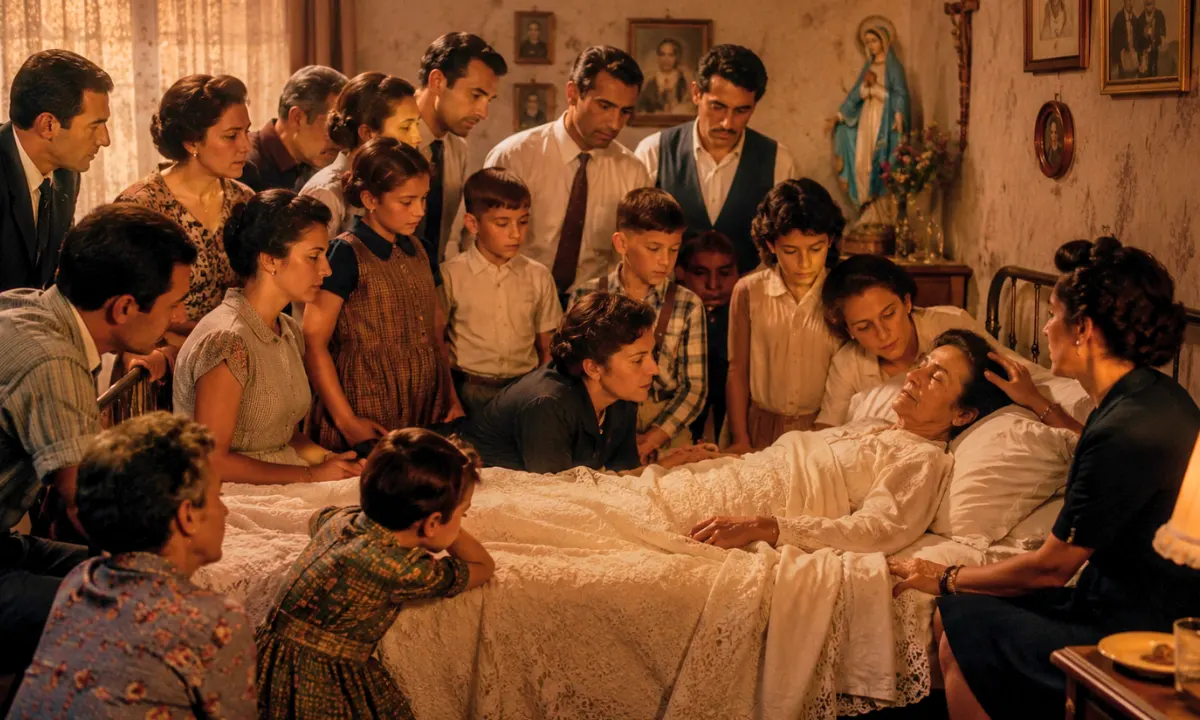
La mamma (The mother) is one of Charles Aznavour’s most famous songs. Released in 1963, the lyrics describe a large Italian family gathering around their dying mother’s bedside. Family members arrive from different places, children play quietly around the room, and everyone tries to comfort her during her final moments. The language is relatively easy to follow, making this song a good choice for intermediate French learners who want to practice family vocabulary, emotions, and everyday French expressions.
In this lesson, we’ll look closely at the lyrics, with clear explanations to help you understand the song and learn useful French vocabulary and grammar.
🎙️ Listen to “La mamma” by Charles Aznavour
Listen to the song first and see how many French lines you can understand before reading the translation notes below.
✏️ La mamma translation and grammar notes
This section breaks down useful French vocabulary, expressions, and grammar from La mamma to help you better understand the lyrics and the language used throughout the song.
🎼 Song Title
La mamma → literal translation: The mother / Mom.
- La mamma uses the Italian word mamma instead of standard French maman.
- The title reflects the family’s affection and Mediterranean cultural setting.
- The song centers on family gathering around a dying mother.
- Repetition of la mamma creates emotional warmth and intimacy.
🧩 Sentence Structures & Grammar
Ils sont venus / Ils sont tous là
👉 “They came / They are all here”
- Sont venus = venir (to come) in the passé composé
- Tous là means “all here” or “all present”
- The opening immediately establishes a family gathering
Dès qu’ils ont entendu ce cri
👉 “As soon as they heard this cry”
- Dès que means “as soon as”
- Ont entendu = entendre (to hear) in the passé composé
- Ce cri means “this cry” or “this shout”
Elle va mourir, la mamma
👉 “The mother is going to die”
- Va mourir = near future tense using aller + infinitive
- The repeated line creates emotional tension throughout the song
- French often repeats nouns after pronouns for emphasis
Même ceux du sud de l’Italie
👉 “Even those from southern Italy”
- Ceux (demonstrative pronoun) means “those ones”
- Du sud de l’Italie = “from southern Italy”
- Reinforces the family’s Italian roots
Y a même Giorgio, le fils maudit
👉 “There’s even Giorgio, the cursed son”
- Y a is informal spoken French for il y a (there is, there are)
- Le fils maudit literally means “the cursed son”
- Suggests a family member who had been rejected or absent
Avec des présents plein les bras
👉 “With gifts filling his arms”
- Plein les bras literally means “full arms”
- Des présents is a formal/literary word for “gifts”
Tous les enfants jouent en silence
👉 “All the children play silently”
- Jouent = jouer (to play) in the present tense
- En silence means “silently”
- The contrast between children and death adds emotion
Autour du lit ou sur le carreau
👉 “Around the bed or on the floor tiles”
- Autour de means “around”
- Le carreau refers to tiled flooring
- Creates a vivid domestic scene
Mais leurs jeux n’ont pas d’importance
👉 “But their games are not important”
C’est un peu leurs derniers cadeaux
👉 “It’s somewhat their last gifts”
- Un peu means “a little” or “somewhat”
- Leurs derniers cadeaux refers emotionally to the children’s presence
On la réchauffe de baisers
👉 “They warm her with kisses”
- Pronoun on = we, people, they
- Réchauffe = réchauffer (to warm)
- De baisers literally means “with kisses”
On lui remonte ses oreillers
👉 “They adjust her pillows”
- Lui is an indirect object pronoun meaning “to her”
- Remonter les oreillers means to prop pillows back up
Sainte Marie pleine de grâces
👉 “Holy Mary full of grace”
- Reference to the Catholic prayer Ave Maria
- Pleine de grâces means “full of grace”
Dont la statue est sur la place
👉 “Whose statue is in the town square”
- Dont replaces de laquelle
- La place means “the town square”
Bien sûr vous lui tendez les bras
👉 “Of course you hold out your arms to her”
- Tendre les bras means “to hold out one’s arms”
- Lui refers to the mother or the Virgin Mary
En lui chantant Ave Maria
👉 “By singing Ave Maria to her”
- En + present participle expresses simultaneous action
- Chantant = present participle of chanter (to sing)
Y a tant d’amour, de souvenirs
👉 “There is so much love and so many memories”
- Tant de means “so much / so many”
- Another example of informal y a
- Souvenir (m.) = memory
Autour de toi, toi la mamma
👉 “Around you, you the mother”
- Repetition of toi adds emotional emphasis
- French songs often repeat pronouns poetically
Y a tant de larmes et de sourires
👉 “There are so many tears and smiles”
- Contrasts sadness and warmth at the same time
À travers toi, toi la mamma
👉 “Through you, you the mother”
- À travers means “through”
- Suggests the mother connects the whole family
Et tous les hommes ont eu si chaud
👉 “And all the men felt so warm”
- Ont eu = avoir in the passé composé
- Avoir chaud means “to feel hot/warm”
Sur les chemins de grand soleil
👉 “On the roads of great sunshine”
- Chemin (m.) = road, way, path
- Poetic imagery referring to Mediterranean life
Qu’ils boivent frais le vin nouveau
👉 “May they drink the new wine cool”
- Qu’ils boivent uses the subjunctive mood
- Le vin nouveau means “new wine”
Le bon vin de la bonne treille
👉 “The good wine from the good vine”
- La treille = vine trellis or grapevine
- Repetition of bon / bonne creates warmth and abundance
Tandis que s’entassent pêle-mêle
👉 “While things pile up in a jumble”
- Tandis que means “while”
- S’entassent = reflexive verb meaning “pile up”
- Pêle-mêle means “mixed together”
Sur les bancs, foulards et chapeaux
👉 “On the benches, scarves and hats”
- Omitted verb creates poetic rhythm
- Lists objects left behind during the gathering
C’est drôle on ne se sent pas triste
👉 “It’s strange, we do not feel sad”
Près du grand lit et de l’affection
👉 “Near the big bed and the affection”
- Près de means “near”
- The bed symbolizes the family center
Y a même un oncle guitariste
👉 “There’s even an uncle who plays guitar”
- Guitariste can mean guitarist or guitar player
Qui joue en faisant attention
👉 “Who plays carefully”
- En faisant = “while doing”
- Faire attention means “to be careful”
Et les femmes se souvenant
👉 “And the women remembering”
- Se souvenant = present participle of se souvenir
- Creates a flowing poetic continuation
Des chansons tristes des veillées
👉 “Sad songs from evening gatherings”
- Les veillées are traditional evening vigils or gatherings
Tout doucement, les yeux fermés
👉 “Very gently, with closed eyes”
- Tout doucement means “very softly”
- Les yeux fermés literally means “the eyes closed”
Chantent comme on berce un enfant
👉 “They sing as one rocks a child”
- Bercer un enfant means “to rock a child to sleep”
- Comme means “as” or “like”
Après une bonne journée
👉 “After a good day”
- Journée (f.) = duration of a day
- Simple everyday expression using après
Pour qu’il sourie en s’endormant
👉 “So that he smiles while falling asleep”
- Pour que triggers the subjunctive
- Sourie = subjunctive of sourire
- En s’endormant means “while falling asleep”
Que jamais, jamais, jamais / Tu nous quitteras
👉 “That never, never, never / You will leave us”
- Quitteras = quitter in the future tense
- Triple repetition of jamais (never) intensifies emotion
- The ending suggests the mother will live on through memory
🔤 Verb Forms & Tenses
- Passé composé: sont venus, ont entendu, ont eu
- Near future tense: va mourir
- Present tense: jouent, n’ont, réchauffe, remonte, tendez, boivent, joue, chantent
- Future tense: quitteras
- Subjunctive mood: qu’ils boivent, pour qu’il sourie
- Present participles: chantant, faisant, se souvenant, s’endormant
- Reflexive verbs: s’entassent, se sent, se souvenant, s’endormant
- Key infinitives: mourir, jouer, réchauffer, remonter, chanter, boire, quitter, sourire
💬 Idioms & Natural Expressions
- y a → informal spoken form of il y a
- plein les bras → arms full
- avoir de l’importance → to matter
- tendre les bras → to hold out one’s arms
- avoir chaud → to feel warm/hot
- pêle-mêle → all mixed together
- faire attention → to be careful
- les yeux fermés → with eyes closed
- bercer un enfant → to rock a child to sleep
- tout doucement → very gently
📘 Vocabulary
- la mamma — mother, mom
- le cri — cry, shout
- le présent — gift, present
- le bras — arm
- le lit — bed
- le carreau — floor tile
- le baiser — kiss
- l’oreiller — pillow
- la grâce — grace
- la statue — statue
- la place — square, plaza
- le souvenir — memory
- la larme — tear
- le sourire — smile
- le chemin — road, path
- le soleil — sun
- le vin — wine
- la treille — grapevine, trellis
- le banc — bench
- le foulard — scarf
- le chapeau — hat
- l’affection — affection
- la veillée — evening vigil, gathering
- la journée — day
- l’enfant — child
🎶 Take your learning to the next level!
FrenchLearner offers one of the largest collections of French song lessons online. Visit the French song lyrics hub to explore classics from the 1950s to the 2000s.
🎵 More Charles Aznavour songs you’ll love
👉 La Bohème »
👉 Emmenez-moi »
👉 Hier encore »
👉 Et pourtant »
📚 See all Charles Aznavour songs »
🇫🇷 More French classic songs you’ll love
👉 La vie en rose (Édith Piaf) »
👉 Non, je ne regrette rien (Édith Piaf) »
👉 C’est si bon (Yves Montand) »
👉 La mer (Charles Trenet) »
About this lesson: I create these song-based lessons to help French learners improve vocabulary, grammar, and cultural understanding in a fun, engaging way. Song lyrics are provided for educational purposes under fair use. All rights to the original works belong to their respective copyright holders.


