
Updated November 16, 2025 — Lesson written by French teacher David Issokson for students who learn French online.
👉 See also: Top 10 French Christmas Songs »
Vive le vent, meaning “long live the wind,” is the well-known French adaptation of the Christmas classic “Jingle Bells”. Although it uses the same melody, the French lyrics are entirely different. In this lesson, you’ll find the complete French lyrics with clear, line-by-line English explanations so you can understand the imagery, vocabulary, and festive spirit of this beloved holiday song.
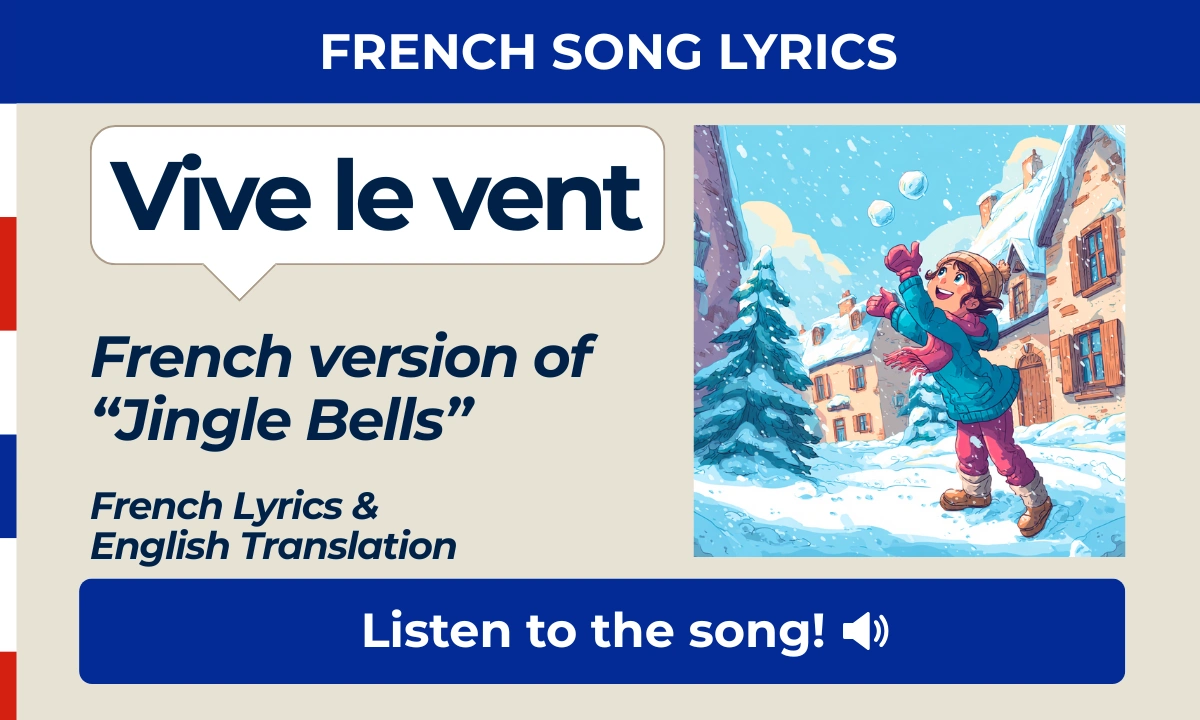
Vive le vent Meaning, Lyrics, and Explanation
📖 Vive le vent — Song Overview
Written by French lyricist Francis Blanche in 1948, the song quickly became a seasonal favorite across France and the French-speaking world. While the original English “Jingle Bells” focuses on sleigh rides and bells ringing, the French version creates a nostalgic winter scene filled with snowy landscapes, bright candles, holiday meals, and the warm anticipation of Christmas celebrations.
The lyrics move through familiar holiday images: green Christmas trees covered in snow, children playing with snowballs, families gathering around festive tables, and the joyful atmosphere that fills the streets during the season.
🎄 Cultural Note
Just like “Petit Papa Noël”, Vive le vent is widely known by children and adults alike. It is sung in schools, played in Christmas markets, and performed in concerts throughout December. Its cheerful melody and vivid winter imagery make it one of the most recognizable French Christmas songs, firmly rooted in the cultural holiday tradition of France.
🎶 Listen to “Vive le vent”
Vive le vent (Jingle Bells) — French lyrics with English translation
Vive le vent, vive le vent
Vive le vent d’hiver
Qui s’en va sifflant, soufflant
Dans les grands sapins verts, oh !
Long live the wind, long live the wind
Long live the winter wind
Which goes whistling, blowing
Through the tall green Christmas trees, oh!
Vive le temps, vive le temps
Vive le temps d’hiver
Boules de neige et Jour de l’An
Et Bonne Année grand-mère !
Long live the season, long live the season,
Long live the holiday season
Snowballs and new year’s day
and happy new year Grandma!
Sur le long chemin
Tout blanc de neige blanche
Un vieux monsieur s’avance
Avec sa canne dans la main
Et tout là-haut le vent
Qui siffle dans les branches
Lui souffle la romance
Qu’il chantait petit enfant, oh !
Along the long road
All white from the white snow
Walks an old man
With his cane in his hand
And the wind way up there
Which whistles in the branches
Blows the romantic tune on him
That he sang as a young child, oh!
Joyeux, joyeux Noël
Aux mille bougies
Qu’enchantent vers le ciel
Les cloches de la nuit
Vive le vent, vive le vent
Vive le vent d’hiver
Qui rapporte aux vieux enfants
Leurs souvenirs d’hier, oh !
Merry, Merry Christmas
To the thousand candles
Which delight toward heaven
The night’s bells.
Long live the wind, long live the wind
Long live the winter wind
Which brings to old kids
Their memories of yesterday, oh!
Et le vieux monsieur
Descend vers le village
C’est l’heure où tout est sage
Et l’ombre danse au coin du feu
Mais dans chaque maison
Il flotte un air de fête
Partout la table est prête
Et l’on entend la même chanson, oh !
And the old man
Goes down toward the village
It’s the time when everyone is good
And the shadow dances near the fire
But in each house
There floats a festive air
Everywhere the table is set
And you hear the same song, oh!
Discover more French Christmas songs!

✏️ Grammar and Vocabulary Notes
The following section highlights key words, expressions, and grammar structures from the song, with short explanations to help learners understand how they’re used.
⚡ Song Title
- Vive le vent = “Long live the wind.”
- Vive is the fixed expression “long live…,” using the subjunctive of vivre.
- Famous parallel: “Vive la France !“
🗣 Sentence Structures & Grammar
“Qui s’en va sifflant, soufflant“
👉 “Which goes whistling, blowing.”
- Qui = relative pronoun “which/that.”
- S’en aller = to go away, to leave.
- Sifflant, soufflant = present participles.
“Dans les grands sapins verts”
👉 “Through the tall green fir trees.”
- Grand = big or tall depending on context.
- Sapin = fir tree → often means “Christmas tree.”
“Vive le temps d’hiver”
👉 “Long live the winter season.”
“Boules de neige et Jour de l’An”
👉 “Snowballs and New Year’s Day.”
- Boule de neige = snowball.
- Jour de l’An = New Year’s Day.
“Sur le long chemin”
👉 “Along the long road.”
- Sur literally means “on,” but contextually translates as “along.”
- Le chemin = road, path or way
“Un vieux monsieur s’avance”
👉 “An old man walks forward.”
- Vieux/vieille = old
- S’avancer = to move or step forward.
- Un monsieur = a man; Monsieur = “sir.”
“Avec sa canne dans la main“
👉 “With his cane in his hand.”
- French uses definite articles with body parts: la main.
“Lui souffle la romance”
👉 “Blows the tune to him.”
- Lui = indirect object pronoun “to him.”
- Romance = melody, romantic tune.
“Qu’il chantait petit enfant”
👉 “That he sang as a young child.”
- Chantait = imperfect → ongoing/undefined past action.
- Indicates childhood habits.
🔤 Verb Forms & Tenses
- Subjunctive (fixed expression): vive
- Present participles: sifflant, soufflant
- Imperfect: chantait
- Reflexive verbs: s’en aller, s’avancer
- Present tense: siffle, souffle, flotte, entend
📚 Idioms & Natural Expressions
- Boule de neige → snowball
- L’effet boule de neige → snowball effect
- Vers le ciel → toward the sky
- Petit enfant → childlike phrasing for “as a little child”
- Bonne Année ! → Happy New Year!
🗣 Grammar Highlights to Notice
- Relative pronoun qui introducing descriptive clauses
- Definite articles with body parts: la main
- Indirect object pronoun — lui: “to him”
- Prepositions showing direction: vers le village, vers le ciel
- Metaphorical vocabulary: romance = melody/tune, not romantic love
📘 Vocabulary
- le sapin — fir tree, Christmas tree
- la boule — ball
- la neige — snow
- le chemin — road, path
- vieux / vieille — old
- la canne — cane
- la cloche — bell
- le souvenir — memory
- flotter — to float
- l’ombre (f.) — shadow
🎄 Want to understand real French this Christmas?
I highly recommend the À Moi Paris audio course by French Today — it teaches French through fun stories and includes both slow and normal-speed recordings. By the way, I also LOVE Camille’s style of teaching!
👉 Get the course here — I’ve used it with my own students for years and they love it.
👉 Read my review
❓ Need extra help with verbs?
🎯 French Verb Drills — Camille’s step-by-step audio drills make conjugations finally click.
👉 See Verb Drills »
If you purchase the courses, I may earn a small commission — at no extra cost to you.
🎄 More French Christmas Songs You’ll Love!
👉 Vive le vent (Jingle Bells)
👉 Mon beau sapin (O Christmas Tree)
👉 Douce Nuit – Sainte Nuit (Silent night)
👉 Minuit Chrétien (O Holy Night)
👉 Noël Blanc (White Christmas)
👉 Ce n’est qu’un au revoir (Auld Lang Syne)
Or see: Top 10 Christmas songs
🎅 More Christmas lessons:
🔤 Word of the Day Christmas Lessons
👉 Joyeux Noël – Merry Christmas
👉 Le sapin de Noël – Christmas Tree
👉 Bonne Année – Happy New Year
👉 French Christmas vocabulary
🚀 Continue learning French online on FrenchLearner!
👉 French Word of the Day »
👉 French Vocabulary lists »
👉 French for beginners guide »
👉 French song lyrics hub »
👉 French conjugations hub


