

Published May 16, 2022 — Lesson written by French teacher David Issokson for students who want to learn French online, with native audio by Marie Assel Cambier, a voice artist from France.
How to say goodbye in French
The most common ways to say goodbye in French are au revoir (goodbye) and salut (bye/hi). You’ll also hear à bientôt (see you soon) à la prochaine (see you next time) and bonne journée (have a nice day).
Free PDF download: 300 Common French Words & Phrases
1. Au revoir — See you again
Au revoir is the most common and most formal way to say goodbye in French. It literally means “until we see each other again,” from au (to) and revoir (see again). Use it in almost any situation, formal or neutral.
2. Salut! — Bye! (Informal)
Salut is another very common way to say goodbye, but it’s informal. Use it only with people you know well, friends, or children. It would be too casual in a business or formal context.
3. À la prochaine — See you next time!
À la prochaine literally means “to the next time” and is short for à la prochaine fois. It’s a friendly way to say “see you next time.”
4. À tout à l’heure! — See you later!
À tout à l’heure means “see you later” but only within the same day. You’d use it when you plan to see someone again in a few hours.
5. À plus tard! — See you later!
À plus tard also means “see you later,” but it’s more flexible. You can use it whether you’ll see the person later the same day or another time in the future.
6. À tout de suite! — See you right away!
À tout de suite literally means “see you right away” or “in a few minutes.” If someone says they’ll be there soon, you can reply, À tout de suite !
7. Adieu! — Goodbye!
Adieu means “farewell” and implies a permanent goodbye, as in “goodbye forever.” It’s rarely used in everyday conversation, except in dramatic or emotional contexts.
8. Ciao! — Bye!
Borrowed from Italian, ciao is very casual and used mostly among friends. In French, it’s equivalent to salut when saying goodbye.
9. Bon, Je te laisse! — Well, I’m off!
Bon, je te laisse ! literally means “Well, I’m leaving you.” It’s a friendly way to end a conversation, especially on the phone. For a formal version, say Je vous laisse. The verb laisser means “to leave”.
10. À demain! — See you tomorrow!
À demain means “see you tomorrow,” with demain meaning “tomorrow.” Simple and friendly — great for classmates or coworkers.
11. À + day of week!
Use à followed by a day of the week to say “see you on [day].” À dimanche ! — See you on Sunday!
12. Je m’en vais! — I’m outta here!
Je m’en vais literally means “I’m leaving.” It’s neutral and can be used in everyday situations when you’re heading out. S’en aller means “to leave”, “to go” or “to be off”.
13. Je me casse! — I’m outta here!
Je me casse is very informal slang meaning “I’m outta here!” The verb casser means “to break,” but se casser means “to take off” or “to get going.”
14. Bonne continuation ! — All the best !
Bonne continuation is a polite expression you say when parting ways for a while. It means “all the best” or “good luck going forward.”
15. Bonjour! — Goodbye in French Canadian
In Québec and some other French-speaking regions of Canada, people sometimes say bonjour at the end of a conversation to mean goodbye. It’s a regional quirk that can surprise visitors!
🎧 Learn French the fun way — with Camille’s À Moi Paris course!
If you’re a beginner, I highly recommend the À Moi Paris audio course by French Today. It’s story-based, taught by my friend Camille, and helps you understand how French is really spoken.
👉 Try the course »
👉 Read my review »
If you purchase the courses, I may earn a small commission — at no extra cost to you.
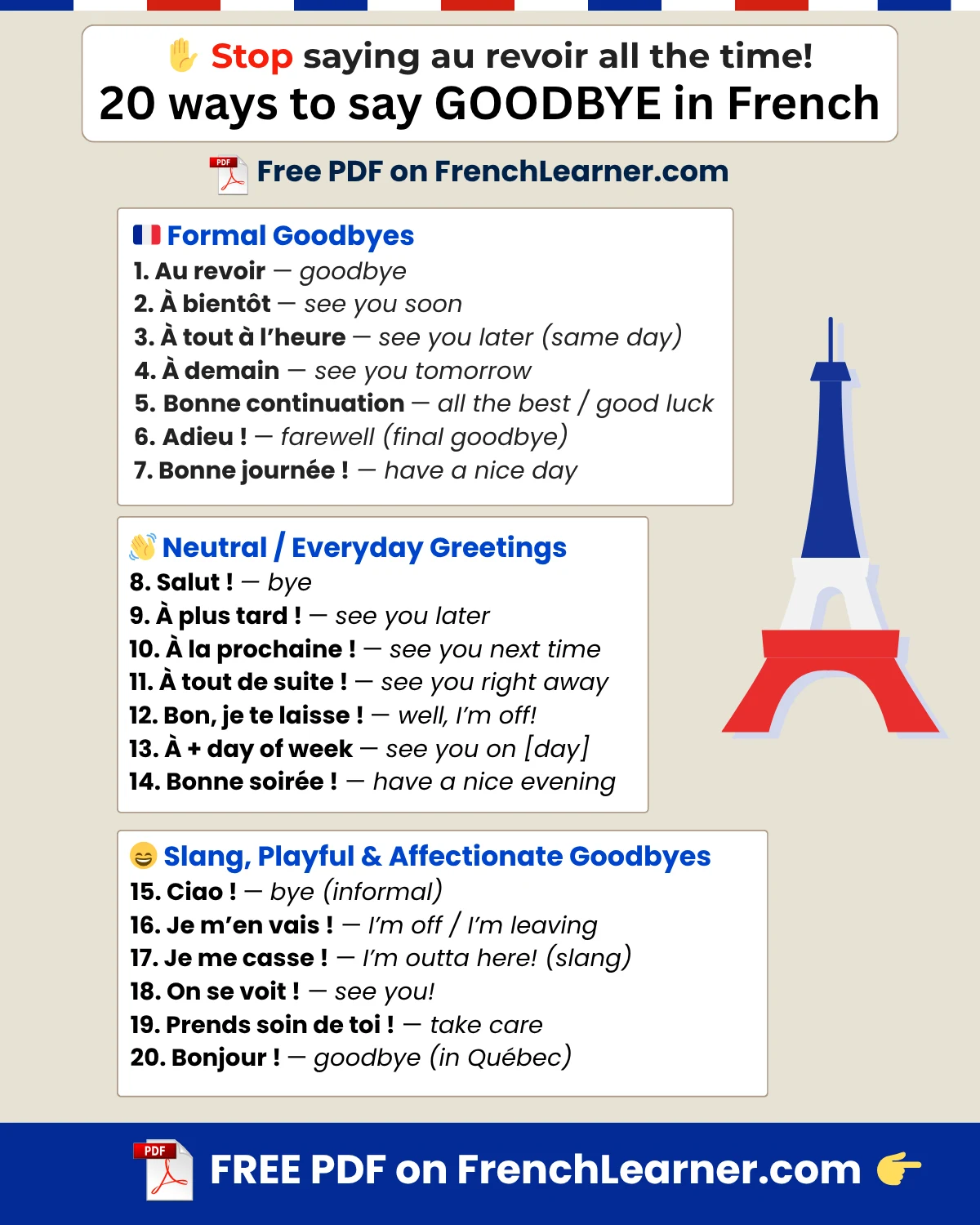
🖼️ Here’s a quick recap you can save or share:
Related lessons
👉 30 French greetings »
👉 20 ways to say hello in French »
👉 À bientôt (see you soon) »
🚀 Continue growing your French vocabulary!
👉 French Word of the Day »
👉 French Vocabulary lists »
👉 French for beginners guide »
👉 French conjugations hub »


