
Jouer is a regular -er verb. This means that its endings in the present tense are the same as other regular -er verbs. The endings in the present tense are: -e, -es, -e, -ons, -ez and -ent. The past participle of jouer is joué (played) and the present participle is jouant (playing).
Jouer conjugation table
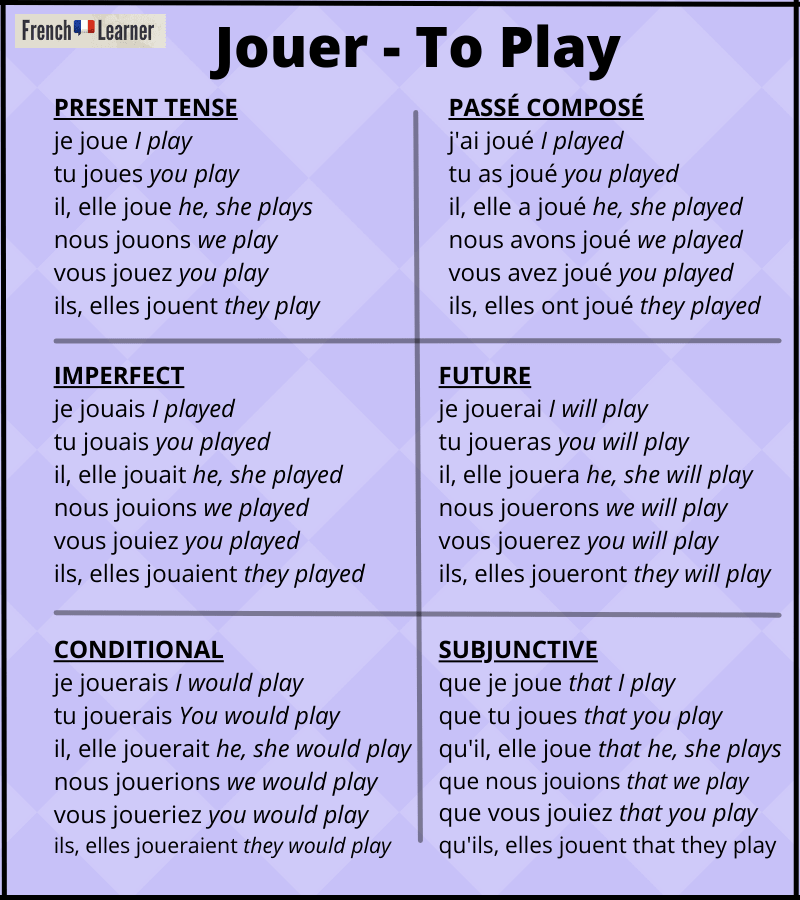
Present tense (le présent)
In the present tense, je joue translates to I play, I am playing and I do play.
| Je joue | I play | Je joue du violon depuis cinq ans. | I have been playing the violin for five years. |
| Tu joues | You play (informal, singular) | Tu joues au foot avec vos camarades de classe. | You play soccer with your classmates. |
| Il/elle joue | He/she plays | Elle joue de la flute devant le public. | She plays the flute in front of the audience. |
| Nous jouons | We play | Nous jouons aux cartes tous les week-ends. | We play cards every weekend. |
| Vous jouez | You play (formal, plural) | Vous jouez un rôle dans la pièce. | You play a role in the play. |
| Ils/elles jouent | They play | Les enfants jouent ensemble après l'école. | The kids play together after school. |
Compound past (le passé composé)
The French use the passé composé to express past actions which occurred at specific times. J’ai joué translates to “I played”.
| J'ai joué | I played | J'ai joué au tennis hier après-midi. | I played tennis yesterday. |
| Tu as joué | You played (informal, singular) | Tu as joué aux dames avec les enfants. | You played checkers with the kids. |
| Il/elle a joué | He/she played | Elle a joué de la harpe quand elle était au lycée. | She played the harp when she was in high school. |
| Nous avons joué | We played | Nous avons joué aux cartes la semaine dernière. | We played cards last week. |
| Vous avez joué | You played (formal, plural) | Vous avez joué du piano pour le concert de Noël. | You played the piano for the Christmas concert. |
| Ils/elles ont joué | They played | Elles ont joué à hockey sur glace contre l'équipe candienne. | They played ice hockey against the Canadian team. |
Imperfect (l’imparfait)
The French use the imperfect tense (l’imparfait) to describe past actions which occurred at undefined times. Je jouais translates to “I used to play” and “I was playing”.
| Je jouais | I was playing, used to play | Je jouais au foot quand les adultes sont arrivés. | I was playing soccer when the adults arrived. |
| Tu jouais | You were playing, used to play (informal, single) | Tu jouais de la guitare quand le public a commencé à applaudir. | You were playing the guitar when the audience started applauding. |
| Il/elle jouait | He was playing, used to play | Elle jouait au volley quand elle était jeune. | She used to play volleyball when she young. |
| Nous jouions | We were playing, used to play | Nous jouions aux cartes quand le téléphone à sonné. | We were playing cards when the phone rang. |
| Vous jouiez | You were playing, used to play (formal, plural) | Vous jouiez du piano pendant très longtemps. | You played the piano for a very long time. |
| Ils/elles jouaient | They were playing, used to play | Les garçons jouaient quand ils étaient jeunes. | The boys used to play together when they were young. |
Simple future (le future simple)
The French use the simple future to express future events. Je jouerai translates to “I will play”.
| Je jouerai | I will play | Je jouerai au foot la semaine prochaine. | I will play soccer next week. |
| Tu joueras | You will play (informal, singular) | Tu joueras de la clarinette au concert ce soir. | You will play clarinet at the concert tonight. |
| Il/elle jouera | He/she will play | Elle jouera avec ses amis demain soir. | She will play with her friends tomorrow evening. |
| Nous jouerons | We will play | Nous jouerons ensemble après l'école. | We'll play together after school. |
| Vous jouerez | You will play (formal, plural) | Vous jouerez un rôle très important dans la politique du pays. | You will play a very important role in the country's politics. |
| Ils/elles joueront | They will play | Ils joueront du violon au festival de musique. | They will play the violin at the music festival. |
Conditional (le conditionnel)
The French use the conditional tense (le conditionnel) to express hypothetical situations which “would” occur. Je jouerais translates to “I would play”.
| Je jouerais | I would play | Je jouerais au foot si j'avais des crampons. | I'd play soccer if I had cleats. |
| Tu jouerais | You would play (informal, singular) | Tu jouerais avec tes amis su tu avais du temps libre. | You would play with your friends if you had free time. |
| Il/elle jouerait | He/she would play | Elle jouerait dehors s'il faisait beau. | She would play outside if it were nice out. |
| Nous jouerions | We would play | Nous jouerions ensemble mais ce n'est pas possible ce weekend. | We'd play together but it's not possible this weekend. |
| Vous joueriez | You would play (formal, plural) | Vous joueriez au basket si la salle de sport était ouverte. | You'd play basketball if the gym were open. |
| Ils/elles joueraient | They would play | Ils joueraient aux cartes s'ils n'étaient pas occupés ce soir. | They would play cards if they weren't busy tonight. |
Subjunctive (le subjonctif)
The French use the subjunctive mood to express wishes, emotions and doubts. Que je joue translates to “that I play”.
| que je joue | that I play | Il est content que je joue du violon. | He's happy that I play the violin. |
| que tu joues | that you play (informal, singular) | Je doute que tu joues avec ton petit frère. | I doubt you're playing with your younger brother. |
| qu'il/elle joue | that he/she plays | Je ne sais pas si elle joue de la flute. | I don't know if she plays the flute. |
| que nous jouions | that we play | Il faut que nous jouions ensemble plus souvent! | We need to play together more often! |
| que vous jouiez | that you play (formal, plural) | Je veux que vous jouiez avec les enfants. | I want you to play with the kids. |
| qu'ils/elles jouent | that they play | Il faut qu'ils jouent une autre chanson. | They need to play another song. |
Verb lessons
- Jouer (Word of the Day)
- Verb conjugation tables
- Explanation of verb tenses
- Top 10 French verbs
- Top 100 French verbs
- Regular verbs
- Irregular verbs
- Reflexive verbs
