
Published May 6, 2026 — Lesson written by French teacher David Issokson for students who want to learn French online. Lyrics provided for educational purposes to support French language learning. All rights belong to the original copyright holders.
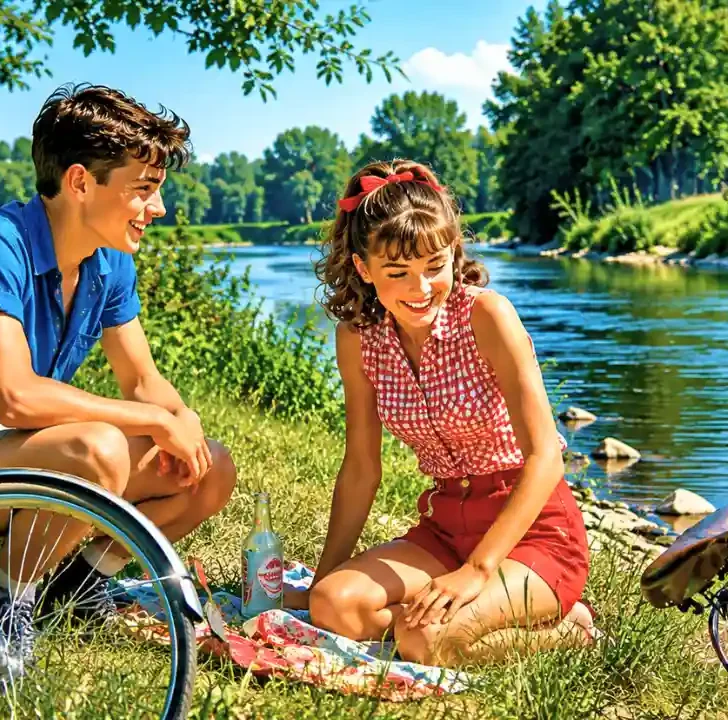
“La bicyclette” is a classic French chanson made famous by Yves Montand in 1968. The title means “the bicycle” and the song nostalgically looks back on youthful bike rides through the countryside with friends and Paulette, the girl all the boys liked. The lyrics celebrate friendship, freedom, first love, and the simple joy of summer adventures in rural France.
In this lesson, you’ll explore the lyrics line by line with clear explanations to help you understand and practice real French.
🎙️ Listen to the song
📘 Meaning in French
✏️ Lyrics and notes

🎙️ Listen to “La bicyclette”
Listen to the song — how many words can you catch before checking the translation?
📘 La bicyclette meaning
“La bicyclette” means “the bicycle” and symbolizes youthful freedom, friendship, and first love. In the song, the bicycle rides through the countryside become memories of carefree summers spent with friends and Paulette, the girl a group of boys all admired. The title captures the nostalgic, romantic atmosphere of simpler times and childhood adventures.
✏️ La bicyclette lyrics translation and grammar notes
The following section highlights selected lyrics that reveal useful French vocabulary, expressions, and grammar structures from La bicyclette, with clear explanations to help you understand how they’re used.
🎵 Song Title
La bicyclette → literal translation: The bicycle.
- La is the definite article meaning “the”.
- Bicyclette (f.) is a slightly old-fashioned but charming word for “bicycle.”
- The title evokes nostalgia, freedom, and childhood memories.
- Today, vélo is more common in everyday French.
🧩 Sentence Structures & Grammar
Quand on partait de bon matin
👉 “When we would leave early in the morning”
- Partait = Partir (to leave) in the imperfect tense
- Pronoun on = we
- Quand means “when”
- De bon matin means “early in the morning”
Quand on partait sur les chemins
👉 “When we would head out on the roads”
- Sur les chemins means “along the paths” or “on the roads”
- Chemin (m.) means “path” or “road”
À bicyclette
- À bicyclette → literal translation: By bicycle / on a bicycle
- The preposition à used for means of transportation.
Nous étions quelques bons copains
👉 “We were a few good friends”
- Nous étions = we were; Être (to be) in the imperfect
- Quelques means “a few”
- Copains (m.p.) is an informal word for friends
Y avait Fernand, y avait Firmin
👉 “There was Fernand, there was Firmin”
- Y avait is spoken French for il y avait; See: Il y a (there is, there are)
- Common informal storytelling structure
Y avait Francis et Sébastien
👉 “There was Francis and Sébastien”
- Continuation of the nostalgic list structure
- Repetition adds musical rhythm
Et puis Paulette
👉 “And then Paulette”
- Et puis means “and then”
- Introduces the important romantic character
On était tous amoureux d’elle
👉 “We were all in love with her”
On se sentait pousser des ailes
👉 “We felt wings growing”
- Expression meaning to feel inspired or uplifted
- Se sentir means “to feel”
Sur les petits chemins de terre
👉 “On the little dirt roads”
- Chemins de terre means “dirt roads”
- Descriptive countryside imagery
On a souvent vécu l’enfer
👉 “We often lived through hell”
- Vecu = past participle of vivre (to live, go through, experience)
- Passé composé used for completed experiences
- L’enfer means “hell”
Pour ne pas mettre pied à terre
👉 “So as not to put a foot on the ground”
- Expression used in cycling
- Mettre pied à terre means to get off one’s bike; See mettre conjugation (to put)
Devant Paulette
👉 “In front of Paulette”
- Devant means “in front of”
- Implies wanting to impress her
Faut dire qu’elle y mettait du cœur
👉 “It must be said that she put her heart into it”
- Faut dire is informal for il faut dire
- Mettre du cœur means to put enthusiasm into something
- See: Il faut (it’s necessary, you have to); Dire = to say, to tell
C’était la fille du facteur
👉 “She was the mailman’s daughter”
- C’était uses the imperfect for background description
- C’était = c’est (it’s, he is or she is) in the imperfect tense
- Facteur means “mail carrier”
Et depuis qu’elle avait huit ans
👉 “And since she was eight years old”
- Depuis que means “since”
- Imperfect tense for ongoing background information
Elle avait fait en le suivant
👉 “She had done while following him”
- En + present participle expresses simultaneous action
- Suivre = to follow
- Le is a definite article referring to her father
Tous les chemins environnants
👉 “All the surrounding roads”
- Environnants means “surrounding”
- Adjective placed after the noun
Quand on approchait la rivière
👉 “When we approached the river”
- La rivière means “river”
On déposait dans les fougères
👉 “We would leave in the ferns”
- Déposer means “to place down”
- Les fougères means “ferns”
Nos bicyclettes
👉 “Our bicycles”
- Possessive adjective nos means “our”
- Repetition reinforces the cycling theme
Puis on se roulait dans les champs
👉 “Then we rolled around in the fields”
- Reflexive verb se rouler
- Romantic and carefree imagery
Faisant naître un bouquet changeant
👉 “Creating a changing bouquet”
- Present participle faisant adds poetic flow
- Faire naître means “to bring forth”
De sauterelles, de papillons
👉 “Of grasshoppers, of butterflies”
- Nature imagery throughout the song
- Papillon (m.) means “butterfly”
Et de rainettes
👉 “And tree frogs”
- Rainette (f.) is a small green tree frog
- Adds vivid countryside atmosphere
Quand le soleil à l’horizon
👉 “When the sun on the horizon”
- Poetic omission of a verb
- Creates lyrical rhythm
Profilait sur tous les buissons
👉 “Outlined on all the bushes”
- Profiler means “to outline” or “shape”
- Visual sunset imagery
Nos silhouettes
👉 “Our silhouettes”
- Silhouette is the same in English and French
- Romantic visual effect
On revenait fourbus, contents
👉 “We came back exhausted, happy”
- Fourbu means physically exhausted
- Multiple adjectives after the verb
Le cœur un peu vague pourtant
👉 “The heart slightly uncertain though”
De n’être pas seul un instant
👉 “From not being alone for one moment”
- Negative infinitive structure
- Un instant means “a moment”
Avec Paulette
👉 “With Paulette”
- Repetition emphasizes longing
- Romantic focus of the song
Prendre furtivement sa main
👉 “To secretly take her hand”
- Furtivement means “furtively” or “secretly”
- Infinitive phrase expressing desire
Oublier un peu les copains
👉 “To forget the friends a little”
- Un peu softens the idea
- Les copains means friends
La bicyclette
👉 “The bicycle”
- Singular form used poetically
- Symbol of youth and freedom
On se disait “c’est pour demain”
👉 “We told ourselves ‘it’s for tomorrow’”
- Reflexive verb se dire
- Direct speech in lyrics
“J’oserai, j’oserai demain”
👉 “‘I will dare, I will dare tomorrow’”
- Future tense of oser
- Demain = tomorrow
- Repetition expresses hesitation
Quand on ira sur les chemins
👉 “When we go on the roads”
- Ira is aller (to go) in the future tense
- Future action after quand
🔤 Verb Forms & Tenses
- Imperfect tense: partait, était, sentait, approchait, déposait
- Passé composé: a vécu
- Future tense: j’oserai, on ira
- Reflexive verbs: se sentir, se rouler, se dire
- Key infinitives: partir, mettre, suivre, déposer, oublier, oser
💬 Idioms & Natural Expressions
- de bon matin → early in the morning
- être amoureux de quelqu’un → to be in love with somebody
- se sentir pousser des ailes → to feel inspired or confident
- mettre pied à terre → to get off one’s bike
- mettre du cœur à l’ouvrage → to put enthusiasm into something
🧠 Grammar Highlights to Notice
- Frequent use of the imperfect tense for nostalgic storytelling
- Spoken French contraction with y avait
- Poetic omission of verbs in some lines
- Repetition used for musical rhythm and emotion
- Strong use of countryside and nature vocabulary
📘 Vocabulary
- la bicyclette — bicycle
- le chemin — path, road
- le copain — friend
- amoureux / amoureuse — in love
- l’aile — wing
- la terre — ground, earth
- le facteur — mail carrier
- la rivière — river
- la fougère — fern
- le champ — field
- la sauterelle — grasshopper
- le papillon — butterfly
- la rainette — tree frog
- le buisson — bush
- la silhouette — silhouette
- fourbu / fourbue — exhausted
- le cœur — heart
- furtivement — furtively, secretly
- oser — to dare
🎶 Take your learning to the next level!
FrenchLearner offers one of the largest collections of French song lessons online. Visit the French song lyrics hub to explore classics from the 1950s to the 2000s.
🎵 More Yves Montand songs you’ll love
👉 C’est si bon »
👉 Les feuilles mortes »
🇫🇷 More French classic songs you’ll love
👉 La vie en rose (Édith Piaf) »
👉 Non, je ne regrette rien (Édith Piaf) »
👉 La bohème (Charles Aznavour) »
👉 Ne me quitte pas (Jacques Brel) »


