
Published December 18, 2025 — Lesson written by French teacher David Issokson for students who learn French online.
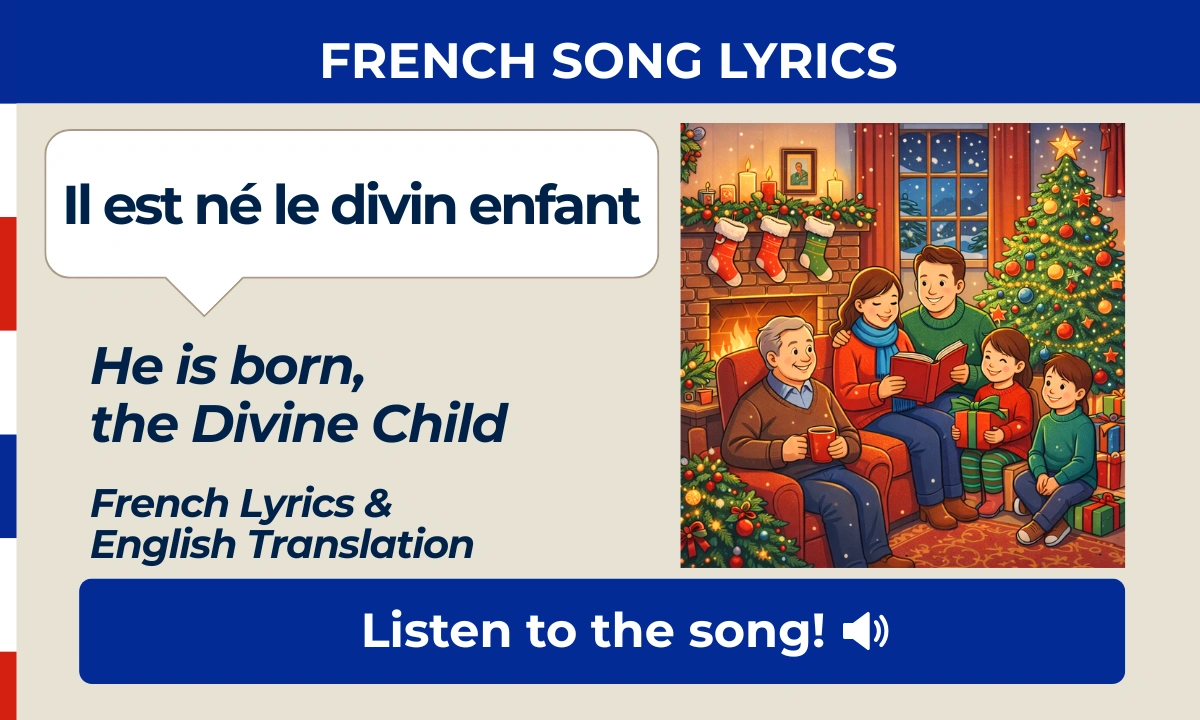
Il est né le Divin Enfant, meaning “He is born, the Divine Child,” is one of the most famous traditional French Christmas carols. Unlike many holiday songs that exist in multiple languages, this song is deeply rooted in French religious tradition. In this lesson, you’ll find the complete French lyrics with clear English explanations to help you understand the vocabulary, grammar, and imagery behind this well-known Christmas song.
📖 Il est né le divin enfant — Song Overview
Il est né le Divin Enfant is a traditional French Christmas carol that dates back to the 18th century. Unlike many French Christmas songs adapted from foreign melodies, this carol developed within French religious tradition and became especially popular in churches and community celebrations. Over time, it has remained one of the most recognizable and widely sung Christmas songs in France.
The song celebrates the birth of Jesus and blends religious imagery with elements of rural French life. Instruments like the oboe (le hautbois) and bagpipes (la musette) evoke village music, while references to a stable, straw, and humility highlight the contrast between divine greatness and simple surroundings. The repeated chorus reinforces joy and wonder, presenting the birth of the Divine Child as a moment of shared celebration, faith, and hope during the Christmas season.
🎄 Cultural Note
Like “Petit Papa Noël” and “Vive le vent,” Il est né le Divin Enfant is known by almost everyone in France. Children often learn it in school, and it is frequently sung in churches, choirs, and community events during December. The song is also commonly heard at Christmas concerts and traditional holiday celebrations.
Its joyful refrain and strong religious imagery give it a special place among French Christmas carols. Because it blends faith, tradition, and simple village imagery, the song remains a familiar and meaningful part of the Christmas season across France and the wider French-speaking world.
🎶 Listen to “Il est né le divin enfant”
Il est né le divin enfant — French lyrics with English translation
Il est né le Divin Enfant
Jouez hautbois, résonnez musettes
Il est né le Divin Enfant
Chantons tous son avènement
He is born, the Divine Child.
Play the oboes and let the bagpipes ring.
He is born, the Divine Child.
Let us all sing about his coming.
Depuis plus de quatre mille ans
Nous le promettaient les prophètes
Depuis plus de quatre mille ans
Nous attendons cet heureux temps
For more than four thousand years,
the prophets promised his coming.
For more than four thousand years,
we have waited for this happy time.
Chorus
Oh, qu’il est beau, qu’il est charmant
Que ses grâces sont parfaites
Qu’il est beau, qu’il est charmant
Qu’il est doux ce Divin Enfant
Oh, how beautiful and charming he is.
His grace is perfect.
How beautiful and charming he is.
This Divine Child is so gentle.
Chorus
Une étable son logement
Un peu de paille est sa couchette
Une étable son logement
Pour un Dieu quel abaissement
A stable is his home.
A little straw is his bed.
A stable is his home.
For a God, this is great humility.
Chorus
Partez, grands Rois de l’Orient
Venez vous unir à nos fêtes
Partez, grands Rois de l’Orient
Venez adorer cet enfant
Go forth, great Kings of the East.
Come and join our celebrations.
Go forth, great Kings of the East.
Come and worship this child.
📝 Grammar and Vocabulary Notes
The following section highlights key words, expressions, and grammar structures from Il est né le divin enfant, with short explanations to help you understand how they’re used.
🎵 Song Title
Il est né, le Divin Enfant → literal translation: “He is born, the Divine Child.”
- Il est né means “he is born.”
- Il est né uses the passé composé with être, required for birth.
- Divin means divine.
- Enfant means child.
🧩 Sentence Structures & Grammar
Jouez hautbois, résonnez musettes
👉 “Play the oboes and let the bagpipes ring.”
- Imperative verbs jouez (jouer, to play), résonnez (résonner, to sound).
- Commands or invitations.
- No articles before instruments, common in songs.
Chantons tous son avènement
👉 “Let us all sing about his coming.”
- Chantons is a first-person plural imperative of chanter (to sing).
- Tous emphasizes inclusion.
- Avènement is formal religious vocabulary meaning arrival or coming.
Depuis plus de quatre mille ans
👉 “For more than four thousand years.”
- Depuis + duration expresses how long something has been true.
Nous le promettaient les prophètes
👉 “The prophets promised him to us.”
- Le is a direct object pronoun referring to the child.
- Promettaient is imparfait, used for repeated or ongoing past actions.
- Inverted word order for poetic emphasis.
Nous attendons cet heureux temps
👉 “We are waiting for this happy time.”
- Present tense of attendre (attendons) creates immediacy.
- Cet is used before a vowel sound.
- Heureux means joyful or blessed.
Oh, qu’il est beau, qu’il est charmant
👉 “Oh, how beautiful and charming he is.”
- Que + sentence expresses strong emotion → “How…!”
Que ses grâces sont parfaites
👉 “How perfect his graces are.”
- Ses is a possessive adjective.
- Grâces refers to divine qualities, not everyday thanks.
Qu’il est doux ce Divin Enfant
👉 “How gentle this Divine Child is.”
- Exclamatory que structure.
- Doux means gentle, sweet, or kind.
- Demonstrative phrasing adds emphasis.
Une étable son logement
👉 “A stable is his home.”
- Noun phrase with no verb, typical of poetic French.
- The verb est is implied.
Un peu de paille est sa couchette
👉 “A little straw is his bed.”
- Un peu de expresses a small quantity.
- Couchette means a small or simple bed.
Pour un Dieu quel abaissement
👉 “For a God, what humility.”
- Quel + noun is an exclamatory structure.
- Abaissement means humility or lowering oneself.
- No verb, increasing emotional impact.
Partez, grands Rois de l’Orient
👉 “Go forth, great Kings of the East.”
- Imperative of partir (to leave) — partez. (See also partir usage examples)
- Grands Rois is an elevated, respectful title.
- Refers to the Biblical Wise Men.
Venez vous unir à nos fêtes
👉 “Come and join our celebrations.”
- Imperative of venir (to come) — venez.
- Se unir is a reflexive verb meaning to join.
- Nos is a possessive adjective.
Venez adorer cet enfant
👉 “Come and worship this child.”
- Infinitive adorer follows venir.
- Cet is used before a vowel sound.
- Simple structure with strong religious meaning.
🔤 Verb Forms & Tenses
- Passé composé: est né
- Imparfait: promettaient
- Present tense: attendons
- Imperative: jouez, résonnez, chantons, partez, venez
- Key infinitives: chanter, jouer, résonner, attendre, adorer, unir
💬 Idioms & Natural Expressions
- Depuis plus de quatre mille ans — for a very long time
- Quel abaissement — expression of humility or astonishment
- Rois de l’Orient — the Wise Men / Kings of the East
🧠 Grammar Highlights to Notice
- Imperative forms used to invite celebration.
- Exclamatory que structures expressing emotion.
- Poetic word order and omitted verbs.
- Religious and elevated vocabulary typical of carols.
📘 Vocabulary
- le divin enfant — the Divine Child
- le hautbois — oboe
- la musette — bagpipe
- l’avènement — coming, arrival
- le prophète — prophet
- l’étable — stable
- la paille — straw
- la couchette — small bed
- l’abaissement — humility
- adorer — to worship
- l’Orient — the East
🎄 Want to understand real French this Christmas?
I highly recommend the À Moi Paris audio course by French Today — it teaches French through fun stories and includes both slow and normal-speed recordings. By the way, I also LOVE Camille’s style of teaching!
👉 Get the course here — I’ve used it with my own students for years and they love it.
👉 Read my review
❓ Need extra help with verbs?
🎯 French Verb Drills — Camille’s step-by-step audio drills make conjugations finally click.
👉 See Verb Drills »
If you purchase the courses, I may earn a small commission — at no extra cost to you.
🎄 More French Christmas Songs You’ll Love!
👉 Vive le vent (Jingle Bells)
👉 Douce Nuit – Sainte Nuit (Silent Night)
👉 Minuit Chrétien (O Holy Night)
👉 Mon beau sapin (O Christmas tree)
👉 Noël Blanc (White Christmas)
👉 Ce n’est qu’un au revoir (Auld Lang Syne)
Or see: Top 10 Christmas songs
🎅 Word of the Day Christmas Lessons
👉 Joyeux Noël – Merry Christmas
👉 Le sapin de Noël – Christmas Tree
👉 Bonne Année – Happy New Year
👉 French Christmas vocabulary
🚀 Continue learning French online on FrenchLearner!
👉 French Word of the Day »
👉 French Vocabulary lists »
👉 French for beginners guide »
👉 French song lyrics hub »
👉 French conjugations hub »


